BLOG OVERVIEW
YouTube Shorts Strategy: How Businesses Should Use Shorts
In
YouTube Strategy
by
Edward Wood

A YouTube Shorts strategy for a business is a plan for how short vertical videos support the rest of your channel: what you post, where the ideas come from and how you’ll judge whether it’s working. My view, after running Shorts for clients from online schools to coaching companies, is that Shorts are a great supporting act and a poor lead. They bring reach cheaply. They rarely bring revenue on their own.
So plan them properly. This article covers where Shorts fit, the formats that work for companies, and the system we use to make them without a separate production line.
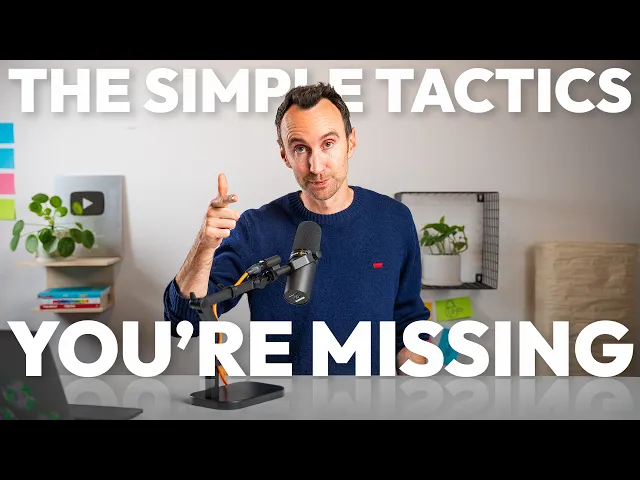
In this video I go through the formats most business channels ignore, from lives and posts to Shorts and reaction videos.
Do YouTube Shorts help a business channel?
Yes, but mostly indirectly. Shorts are very good at putting your brand in front of new people. They’re much worse at turning those people into customers, because a 40-second clip watched in a swipe feed doesn’t build the trust a buying decision needs.
The hardest part for business channels is attribution. Shorts views are very hard to connect to sales. A long-form video that answers a buyer’s question is far easier to trace through to a sign-up or a sales call. The numbers also got harder to compare in 2025, when YouTube changed how Shorts views are counted so that every start or replay counts. View counts went up overnight without anything else changing.
So we judge Shorts on what they do for the rest of the channel. Do they bring subscribers who then watch long-form videos? Do they get people searching for the brand? If the answer is no after a few months, we change the approach.
What should a YouTube Shorts strategy include?
Three decisions, made before anyone films anything.
The job. Reach new viewers, re-engage subscribers or support a launch. Pick one per run of Shorts.
The source. Where the ideas come from. For most companies the best answer is your own long-form videos, webinars and lives.
The measure. Subscribers gained, long-form views from Shorts viewers, branded search. Not views on their own.
If you’re new to the numbers, our YouTube Shorts benchmarks show what’s normal for a new channel, so you don’t panic at 200 views.
Why should you cut Shorts from long-form videos?
Because it’s the cheapest way to make good Shorts, and it keeps every Short tied to something deeper.
A well-researched long-form video already has the strongest moments in it: a sharp claim, a surprising number, a story with a punchline. Cutting those into Shorts is a quick editing job. Making Shorts from scratch means separate ideas, scripts and shoots, and most business teams can’t keep that up.
With Masterschool, an online tech school, we paired each weekly long-form video with a run of Shorts drawn from the same research. Over the project that came to 16 long-form videos and around 80 Shorts, and more than 200,000 views in a very niche market. With Fired Up, a Berlin coaching company, Shorts cut from their long-form videos ended up as some of their best-performing Instagram Reels and LinkedIn videos too.
Webinars and lives work the same way. An hour-long session gives you plenty of clips. Our webinar marketing strategy article covers how we plan for that from the start.
Since October 2024, Shorts can run up to three minutes, which makes it easier to keep a whole point intact rather than cutting it off mid-sentence.
Which Shorts formats work for businesses?
The same principle applies as on long-form: pick the format before the topic. Our guide to YouTube video formats goes through nine of them. For Shorts, three stand out.
Reaction content
Reacting to something your audience already cares about gives you a ready-made hook. Nothing, the phone company, is the best example I know. A lot of its YouTube content has the CEO, Carl Pei, on camera, setting the record straight on reviews and reviewing competitors’ phones. Trade press noticed how unusual that was for a hardware brand, and afaqs wrote it up as a strategy in its own right.
It works on long-form too. On one client channel, moving from talking-head explainers to reaction videos doubled average watch duration and led to the channel’s first breakout video.
One question, one answer
The Short version of a search video. One question your customers ask, answered in under a minute, with the long-form video linked for anyone who wants the detail. These Shorts age well and feed people into the longer content.
The best moment
The single strongest 30 to 60 seconds from a long video, a webinar or a podcast. Pick moments that make sense without context, then add on-screen text so they work on mute.
When are Shorts the wrong priority?
When your best format is long. With Haven, we’re building the channel around full-length yoga sessions that people follow from start to finish. Those videos hold viewers for a long time, and that’s where the value is. Shorts can point people to them, but the strategy is built on the long sessions, and splitting the team’s time evenly would weaken both.
The same goes for any business where trust is the bottleneck: high-priced products, health, education, B2B software. Put most of your effort into long-form, then cut Shorts from it. Our audience retention guide has a section on Shorts retention if you want to compare the two properly.
And if you’re trying to grow beyond your first few thousand subscribers, look at what’s already breaking out in your niche before deciding what to cut. Finding YouTube outliers works for Shorts as well as long-form.
FAQ
How often should a business post YouTube Shorts?
As often as your long-form schedule can feed. With one long-form video a week, three to five Shorts a week is realistic without extra filming. That’s roughly the ratio we ran with Masterschool.
Do YouTube Shorts hurt long-form performance?
We haven’t seen it on the channels we run. The bigger risk is time: a team chasing Shorts views can let the long-form quality slip.
Should Shorts be on a separate channel?
Usually not for a business. Keeping them on the main channel means any subscriber they bring in also sees your long-form videos. A separate channel makes sense only if the Shorts serve a completely different audience.
How long should a YouTube Short be?
As long as the point needs, up to three minutes. Keep each Short to a single idea. For clips cut from long-form, that’s usually well under a minute.
Can you make money from YouTube Shorts?
Shorts can earn a share of ad revenue through the YouTube Partner Programme, under YouTube’s Shorts monetisation policies, but for most businesses the payout is small. The value is in the customers and subscribers they bring in, which is why we measure them on those.