BLOG OVERVIEW
YouTube Outliers: How to Find Them and When to Ignore Them
In
YouTube Strategy
by
Edward Wood

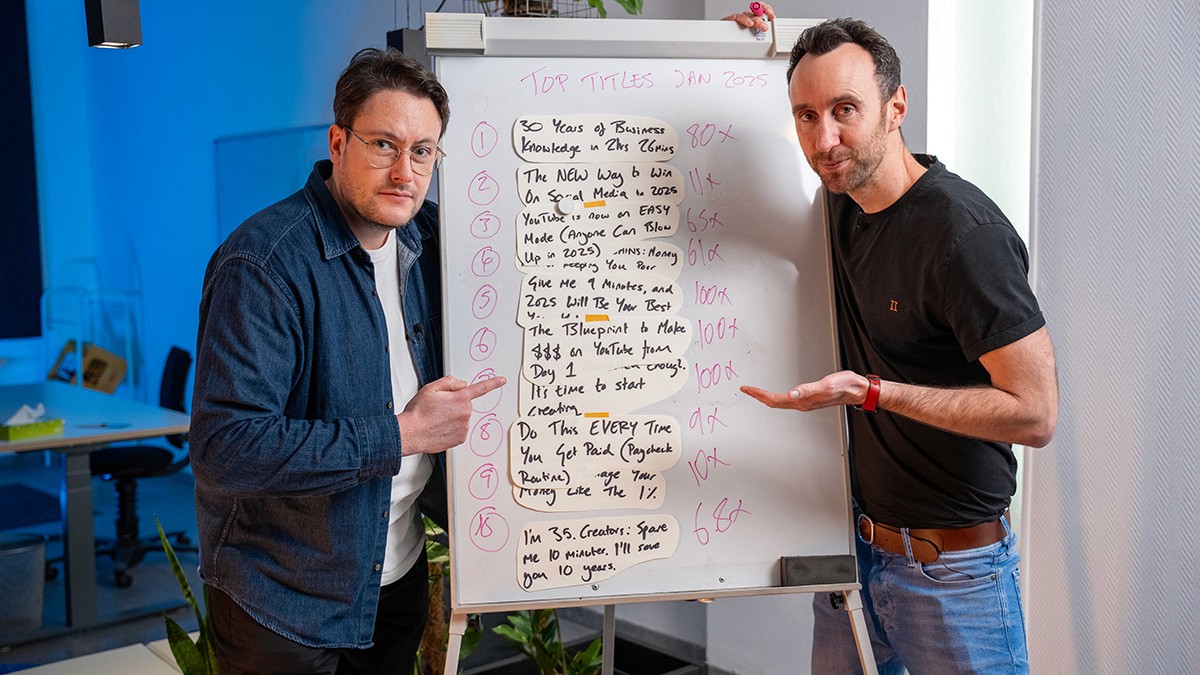
YouTube outliers are videos that perform far better than the channel that published them usually does. A video with 400,000 views on a channel that normally gets 20,000 is an outlier. It tells you that a topic, title or format hit a nerve with an audience, and that’s useful information if you make videos for the same people.
The outlier strategy, finding those videos and making your own version of them, is one of the most popular growth methods among YouTube creators right now. We use it with clients such as 9x. But it isn’t the only way to grow a business channel, and for a new channel it’s often not the best place to start. This article covers how to find outliers, how to use them without copying, and when to put them aside.
Before any tools, it helps to see how much you can learn from YouTube’s own search bar. My co-founder Calum shows the manual version in this video.
What makes a YouTube video an outlier?
An outlier is measured against its own channel, not against YouTube as a whole. A video with 50,000 views is unremarkable on a channel of two million subscribers. On a channel whose videos usually get 2,000 views, it’s a breakout.
So the number that matters is the ratio: a video’s views divided by the channel’s typical views per video. Tools such as vidIQ’s Outliers feature calculate a score along these lines. Anything several times above the baseline is worth a look. Anything ten times above it is worth a proper study.
Outliers happen because YouTube’s recommendation system tested the video with a small audience, saw that people clicked and kept watching, then showed it to more and more viewers. If you want the mechanics, I go through them in how YouTube videos get views. The short version: an outlier is a video the algorithm decided to push, and the packaging and opening usually explain why.
How do you find YouTube outliers?
There are two ways, and we use both.
By hand. Search your topic on YouTube, open the channels that come up, sort by most popular and compare each video’s views with the channel’s subscriber count and recent averages. Then do it again on the next channel. It works, but it takes hours, and it’s biased. You search in your own language, you see videos served to your country, and you mostly look at channels you already know.
With Claude and the YouTube API. This has changed how we brief videos more than anything else in the last year. We connect Claude to the YouTube API and vidIQ, give it a topic, and it pulls the channels, works out each channel’s baseline and ranks every video by how far it beat that baseline. It has no favourite channels and no home language. The outliers it surfaces are often ones we’d never have found: a breakout in German, or a title from a creator in a completely different niche whose format would suit ours.
The output is a brief: the topic, the keywords, the reference videos, what they have in common and why our version should work. We walk through the whole research stack in our Claude YouTube SEO video.
How do you turn an outlier into your own video?
The way I describe it to the team is copy, pivot, flip and twist. You copy what made the video work, then change enough that it’s yours.
Copy the underlying promise. What did the viewer want when they clicked? A shortcut, a comparison, a story, a reveal?
Pivot it to your audience. A fitness creator’s “I tried every protein powder” can become “I tried every CRM for small agencies”.
Flip the angle. If the outlier is “Why X works”, there may be room for “Why X stopped working”.
Twist the format. A talking-head outlier can become a screen recording, a reaction or a challenge. Our guide to YouTube video formats covers the options.
What you leave alone is the content itself. Viewers notice, and they leave. YouTube judges a video partly on whether people found it worth their time, so a weaker copy won’t travel far. Your version has to add something: your data, your experience, a sharper answer.
Why shouldn’t new business channels start with outliers?
Because outliers optimise for views, and a new business channel needs buyers first.
Most outliers are broad. They win because they appeal to a huge audience. That’s great for a creator who earns from ads. For a company selling to a specific kind of customer, a broad video can bring thousands of viewers who will never buy anything.
When a channel is starting out, I’d rather it answered the questions customers already ask. The quickest source is your sales team. Ask them which questions come up on every call, which objections they keep handling and which competitor names prospects mention. Each one is a video, and our list of YouTube video ideas for business has more prompts like this.
These videos rarely take off in the first week. That’s fine. They’re found through YouTube search over months, they bring in the right viewers, and in our experience they convert far better than a viral video aimed at everyone.
When should a channel switch to an outlier strategy?
We tend to build a channel in layers, and outliers come in once the first layers are working.
YouTube-first SEO. Videos on topics your website already ranks for, turned into articles that rank too. I explain the process in does embedding YouTube videos help SEO.
Customer questions. The sales-team and ICP videos above, mostly found through search.
Outliers. Once you have an audience and some data on what they watch, outliers help you reach the next ring of viewers through browse and suggested.
Lives and webinars. For converting the audience you’ve built. We cover this in our webinar marketing strategy article.
The order isn’t fixed. A channel with an existing audience elsewhere, such as a big LinkedIn following, can bring outliers in sooner. But the principle holds: earn the right viewers first, then go after more of them.
FAQ
What is a good outlier score on YouTube?
There’s no official number, because outlier scores are calculated by third-party tools, not YouTube. As a rule of thumb, we pay attention to videos at three or more times their channel’s baseline and study anything at ten times or more.
Is copying YouTube outliers allowed?
Copying the idea, the format or the type of title is how most of YouTube works. Copying someone’s footage, script or thumbnail is not, and it won’t perform well anyway. Change the angle and add your own material.
Can outliers come from small channels?
Yes, and those are often the most useful. A small channel’s breakout shows that the topic or packaging did the work, not an existing audience.
Do outliers work for B2B channels?
They can, once the channel has a base of the right viewers. Look for outliers in adjacent business niches rather than in entertainment, and check that the topic connects to a problem your product solves.
How often should you do outlier research?
We run it for every video brief. It takes minutes with an automated setup, and it’s one input alongside search data and customer questions.