When you think of YouTube, the format that comes to mind is probably the talking head. An expert in front of a camera, breaking down a topic. And for good reason: it's high impact and low effort, the top-left corner of the action priority matrix. But if all you ever produce is talking-head content, your channel gets predictable, both for you and for your audience.
Over the past decade, I've deployed every format I'm about to describe across channels at Babbel, CareerFoundry, and now through Humble&Brag's client work. The single biggest lesson: format choice directly affects how a video "behaves" at a business level. You can see it in the metrics. Some formats drive views but not conversion. Others convert brilliantly but get fewer views. The most effective channels run multiple formats, each serving a different function in the content strategy.
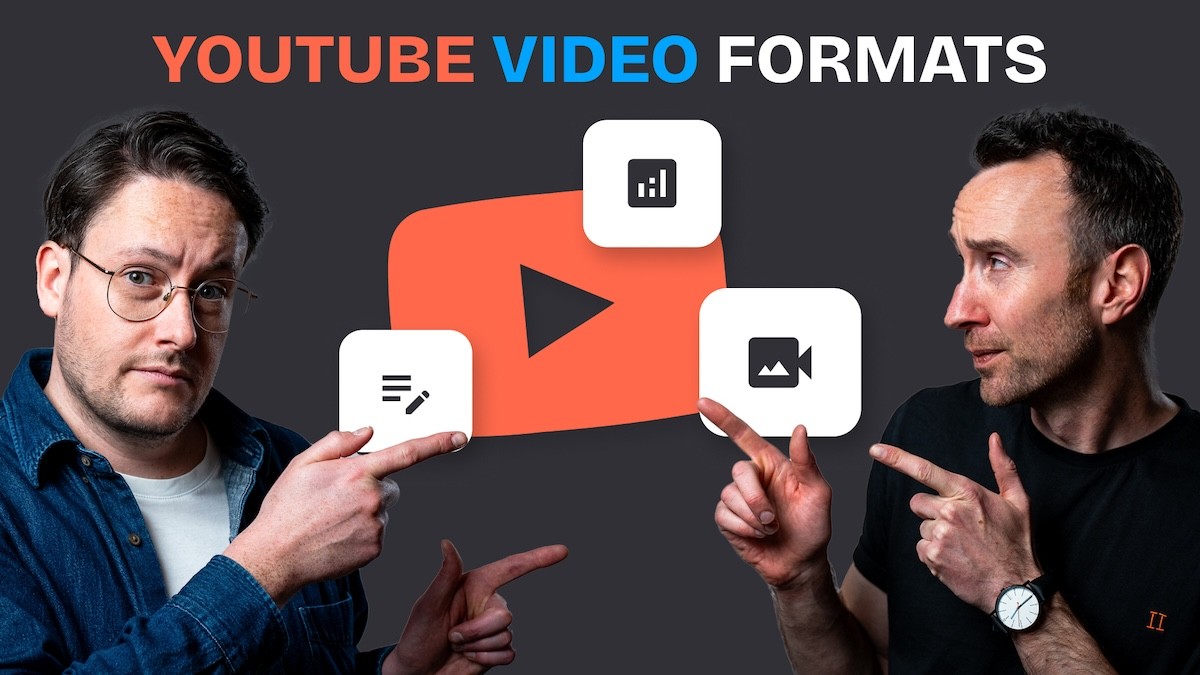
This guide ranks seven formats by their impact on business channels, with real examples and the pros and cons of each.
1. The Talking Head
The standard expert-to-camera format. Done well, it's the workhorse of any business channel because it's quick to produce, easy to iterate on, and builds trust through direct eye contact and personal authority.
Alex Hormozi, Ali Abdaal, and Deya have optimised this format to its extreme: tight hooks, animated openings, jump cuts for pacing, and charismatic delivery. But the talking head also works for less polished presenters who bring genuine expertise. RP Strength built nearly 2 million daily views largely through one expert (a professor of exercise science) speaking directly to camera with minimal production.
We nearly always recommend that business channels start here. It provides a low-risk, fast introduction to YouTube production and lets you test topics and messaging without significant investment. Select one or two hosts from within your company (the more senior and knowledgeable, the better) and begin with the questions your customers ask most often.
Pros: Lowest production cost, fastest to iterate, builds direct trust and credibility, ideal for search-driven intent content. Cons: Can become repetitive if it's the only format, success depends heavily on the host's delivery.
2. Reaction Content
An expert critiques or analyses the work of a practitioner, using existing footage as the raw material. The formula: familiarity (the viewer recognises the subject being reviewed) plus authority (your expert provides a perspective the viewer can't get elsewhere).
Nothing built their entire channel strategy on this format, with CEO Carl Pei reviewing competitor products like the iPhone. Their most popular video, "Nothing CEO Reviews iPhone 14 Pro," has 4.4 million views. RP Strength's Mike Israetel critiques celebrity exercise regimes, generating billions of total views. In both cases, the reaction format creates a parasitic distribution effect: by reacting to high-search-volume subjects (iPhone launches, celebrity fitness), the channel captures attention from audiences that would never have searched for the brand directly.
We found that reaction content typically drives over double the average watch time compared to a standard talking head from the same channel. The existing footage provides visual variety that holds attention, and the expert commentary creates a running curiosity loop: what will they say next?
Pros: High watch time, strong reach and discovery, can be produced with relatively low effort (select clips, prepare talking points, film). Cons: More of a brand play than a conversion play. Viewers are consuming entertainment rather than education, so downstream conversion tends to be lower than talking-head tutorials.
3. Challenge Content
An expert or novice challenges themselves to accomplish a task in an improbably short time, often using the company's product. The format creates a natural story arc with obstacles, setbacks, and a resolution.
At Babbel, we challenged hyperpolyglots to learn languages in a week, sometimes even an hour. These videos became full campaigns with articles, ads, and PR created from the same content, and they drove double-digit growth for the company. The product appeared implicitly throughout the content as the tool used to achieve the challenge, which meant the viewer experienced the product's value without being sold to directly.
The inspiration for this format at Babbel was Buzzfeed's The Try Guys, and we took that further with our "Unpronounceable Words" series: a few people in a room no bigger than a cupboard, challenged to pronounce words in different languages. The series clocked up well over 10 million views.
Pros: Strong views and retention due to natural narrative tension, excellent for product demonstration, highly shareable. Cons: Higher production effort than talking head or reaction. Requires enlisting participants and potentially documenting over a period of time. Can be simplified significantly (the "cupboard" format proves this).
4. The Listicle Reveal
As Ali Abdaal puts it: "Everything is a list. If you're struggling to write a video, try thinking of it as a title, a thumbnail, and a list." The listicle reveal is a specific variation where each point builds on the last to achieve a larger goal, creating a roadmap the viewer has to watch in full to reach the destination.
Ali Abdaal's biggest video, "9 Passive Income Ideas: How I Make $27k Per Week" (13 million views), follows this structure precisely. The goal is compelling enough that the viewer commits to all nine steps. The video you're reading about now follows the same structure: seven formats for a full-funnel YouTube strategy.
The listicle structure lends itself to clean scripting because each point is a self-contained unit with its own promise, build, and payoff. This makes the format easy to brief, easy to write, and easy to edit.
Pros: Easy to produce, natural structure aids scripting, strong retention when each point genuinely builds. Cons: Can feel formulaic if overused. The format is well-known enough that viewers may disengage if the individual points aren't genuinely valuable.
5. Founder-Led Content (Building in Public)
Founders and CEOs carry a natural authority that employees and hired presenters don't. They've conceived and launched a company, know the competitive landscape intimately, and can offer a perspective that's genuinely unique.
Nothing's CEO doesn't just appear in the occasional brand campaign; he is the content. He reviews competitors, reacts to reviews of his own products, and occasionally roasts employees. As a strategy, it's ingenious: a small electronics company gets share of voice alongside Apple by piggybacking on the attention around iPhone launches.
Founder-led content also works at a smaller scale. A SaaS founder explaining the thinking behind product decisions, a consultancy founder sharing the frameworks they use with clients, a restaurant owner walking through their kitchen workflow. The common thread is transparency and access: viewers get to see behind a curtain that's normally closed.
Pros: High authenticity, impossible for competitors to replicate (they don't have your founder), builds strong personal brand that benefits the company. Cons: Founder time is scarce and unpredictable. Consistency is the biggest challenge. If you can get even one to two hours per month of founder time on camera, it's worth the effort.
6. Podcasts and Interviews
Every marketer rolls their eyes at podcast recommendations. Fair enough. The world doesn't need another podcast, and podcast episodes on YouTube typically get modest view counts compared to other formats.
But podcasts serve a different purpose on a business channel. They provide your existing audience with content that builds a personal connection, the kind of content that turns a viewer into a genuine fan. If you invite guests, podcasts also build valuable industry relationships. And clipped podcast content provides some of the best-performing short-form material for LinkedIn, which in 2026 is aggressively promoting video.
We've personally found that podcast clips work extremely well for distribution even when the full episodes don't generate large YouTube view counts. The clips are personal, accessible, and work as "animated selfies" on professional platforms.
Pros: Deepens relationship with existing audience, builds industry connections, provides excellent short-form content for LinkedIn and social distribution. Cons: Low view counts on YouTube. Should complement other formats, not replace them.
7. The Converter (Lead Magnet Walkthrough)
Most content creators focus on the top of the funnel. They want views first and measure second. The converter is the opposite: a step-by-step walkthrough of a free resource, course, or tool that exists as your lead magnet.
At CareerFoundry, we created a video showcasing our free UX design short course: an expert walked viewers through the course one tutorial at a time, demonstrating exactly what they'd get. The video got far fewer views than the channel's top performers (around 52,000 over several years), but the conversion rate was 20 to 30 per cent compared to the usual 3 to 4 per cent on other videos. People watched the video, clicked the link in the description, signed up for the free course, completed it, received a discount code, and converted to the paid programme.
The entire sales journey for some viewers, from discovery to purchase of an €8,000 product, happened because of one strategically crafted video.
Pros: Highest conversion rate of any format, makes the next step for the viewer completely obvious, generates trackable attribution data. Cons: Low view counts because the content is narrow and specific. That's fine, because the business value per view is dramatically higher.
How to Choose Your Format Mix
Don't try to launch with all seven formats. Start with the talking head (it gets you consistent and builds a library), then add one additional format based on your goals.
If you need awareness: add reaction content or challenge content. If you need conversion: add the converter format. If your founder is willing: add founder-led content. If you're established and want to deepen your audience: add podcasts.
The companies that grow fastest on YouTube start with one format that works, build consistency around it, then gradually expand. RP Strength started with reaction content and later branched into challenges, collabs, and documentaries. Nothing started with CEO reviews and expanded into vlogs and behind-the-scenes. In both cases, the core format that drove initial growth remains the pillar of the channel.
For the full framework on how format selection fits into your broader strategy, see our YouTube content strategy guide. If you want help selecting and testing formats for your channel, a channel audit will diagnose what's working and recommend what to try next.