Why do some YouTube videos languish at 3 views while others explode to 3 million?
Last week, I opened YouTube looking for a quick distraction. A thumbnail caught my eye—something about treehouse construction that I didn't know I needed to watch. Thirty minutes later, I'd watched four more videos on the topic and was genuinely considering buying some power tools. I wasn't searching for treehouses. I wasn't subscribed to carpentry channels. YouTube just... knew.
That's the magic and mystery we're unpacking today. By the end of this article, you'll understand exactly how YouTube's recommendation engine works—and more importantly, how to make it work for you. Whether you're just starting out or you're a seasoned creator hunting for systematic growth, this is your blueprint.
Where Views Actually Come From
Think about the last YouTube video you watched. Seriously, pause for a second and recall it. How did you discover it?
Maybe a friend sent it to you on WhatsApp. Maybe someone dropped the link in a Reddit thread. Maybe you were searching Google and it appeared in the results. Maybe you were reading a blog post and the video was embedded right there. Maybe you got a push notification from a channel you subscribe to.
Or maybe—just maybe—you opened YouTube and there it was on your homepage, the exact video you didn't know you wanted to watch.
These are just some of the ways viewers discover videos, and YouTube Analytics tracks all of them. You can find this data in the Reach tab of YouTube Studio, or dig deeper into Advanced Analytics for a granular breakdown.
But knowing where views come from only scratches the surface of understanding how videos actually grow. For that, we need to go deeper.
The Three Types of Distribution: 1:1, 1:Many, and 0:Many
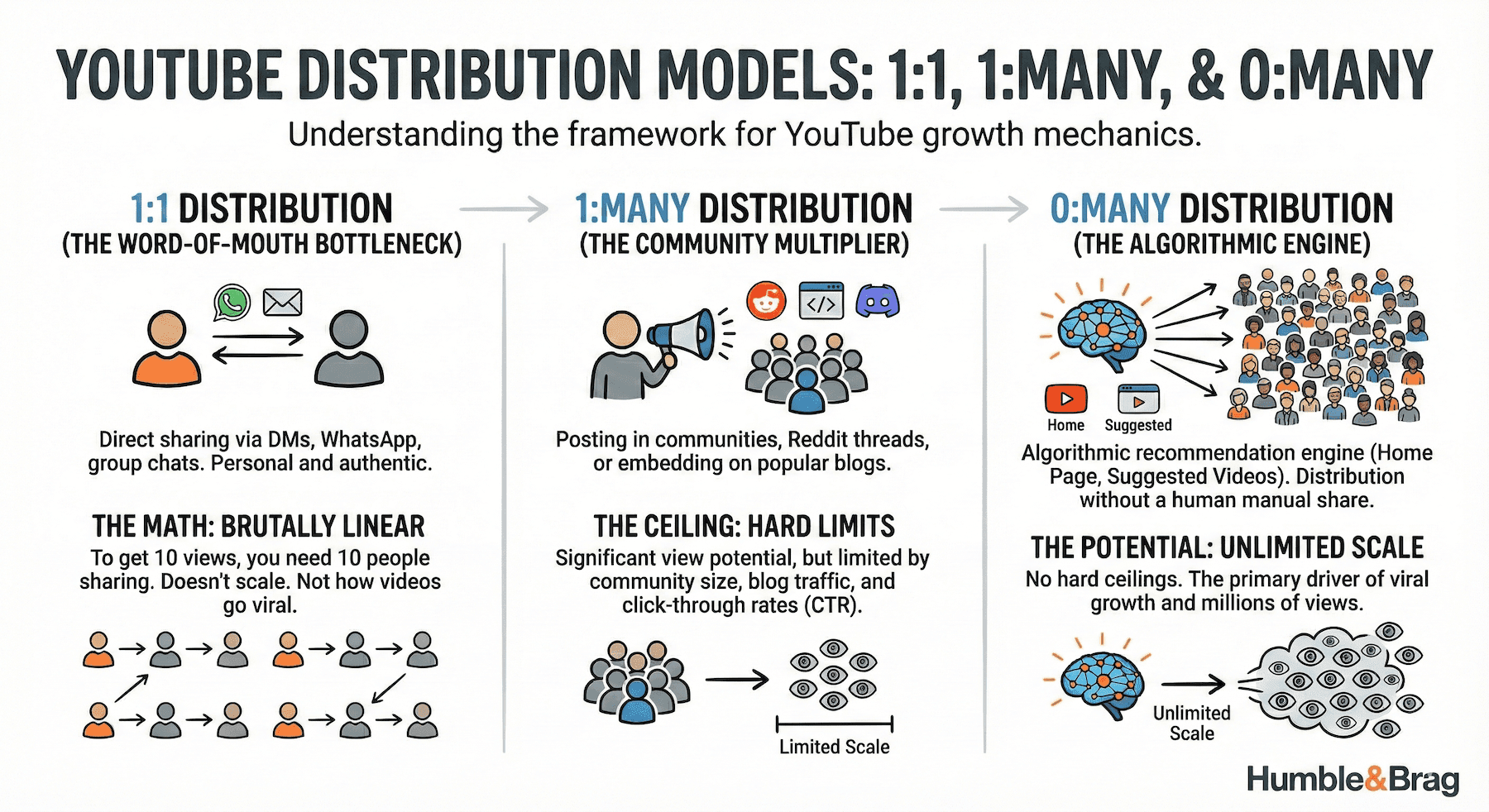
Let's categorize those discovery methods into three fundamental types of distribution. Understanding this framework is the key to grasping YouTube growth mechanics.
1:1 Distribution: The Word-of-Mouth Bottleneck
WhatsApp messages, direct recommendations, even group chats—these are 1:1 (or 1:Few) relationships. One person shares with one other person.
The problem? The math is brutally linear. To get 10 views, you need a chain of 10 people sharing. To get 1,000 views, you need 1,000 individual sharing actions. It's personal and authentic, but it doesn't scale. This isn't how videos go viral.
1:Many Distribution: The Community Multiplier
Now we're getting somewhere. This is when one person makes a video discoverable to many—posting it in a Reddit thread, sharing it in a Discord community, or embedding it on a popular blog.
You can see how this could drive significant views, especially if the video appears on a breaking news article or gets posted in a thriving community. But there are still hard ceilings: the number of blog visitors, the size of the community, and critically, the click-through rate from those who actually see it.
Can 1:Many drive growth and quality views? Absolutely. Can it generate millions of views? Probably not on its own.
0:Many Distribution: The Algorithmic Unlock
This is where things get interesting. The "0" represents the algorithm—or more accurately, the network of algorithms that comprise YouTube's recommendation engine.
No human is manually sharing your link. Instead, the system analyzes viewing habits and deploys collaborative filtering (comparing your behavior to similar users) to predict what you're most likely to engage with. When your video matches what a viewer is likely to enjoy right now, the system places it on their Home Page or as a Suggested Video.
Here's the game-changer: algorithmic recommendation drives 70% of total watch time on YouTube. If you look at your own Analytics, you'll typically see a similar percentage.
And here's the critical insight: there's essentially no limiting factor. About 3 billion people watch YouTube every month, and the algorithm can decide to show your video to none of them, all of them, or (most likely) somewhere in between.
So at the intermediate level, the answer to "how do videos really grow?" is simple: recommendation.
But to truly master YouTube growth, we need to understand which signals the algorithm listens to, which parts of the system matter most, and how non-algorithmic sparks can trigger algorithmic expansion.
How YouTube Decides Everything: Signals, Systems, and Sparks
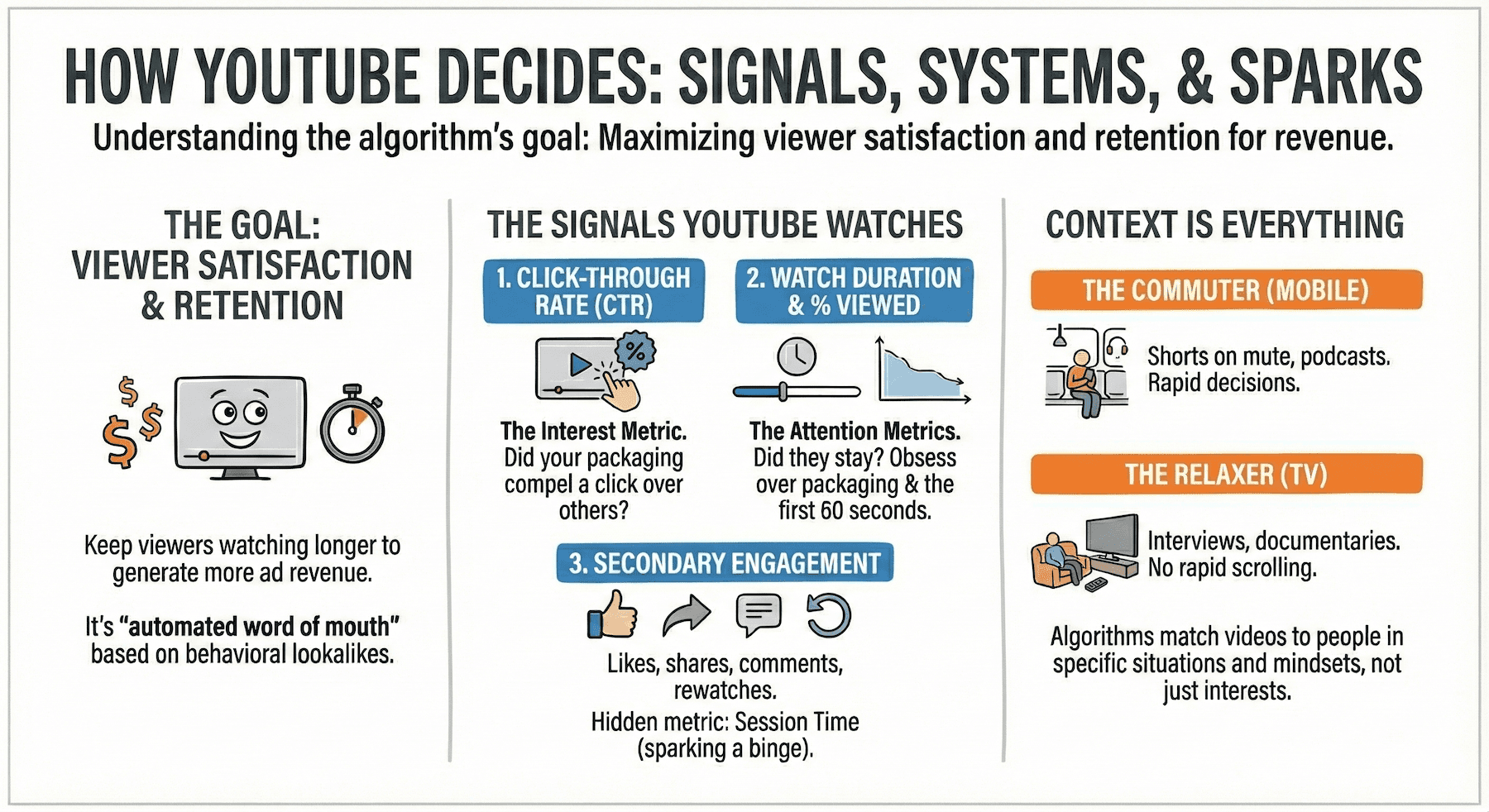
YouTube has one overriding goal: viewer satisfaction. Satisfy viewers so they start watching and keep watching videos on the platform. Why? Because the longer YouTube retains viewers, the more revenue it generates through advertising.
To achieve this, the system analyzes countless signals to predict what each viewer wants to see next. It's essentially "word of mouth, automated"—instead of asking a friend what to watch, you get recommendations from millions of behavioral lookalikes whose data says, "people like you loved videos like this."
The Signals YouTube Watches
When creators say "the algorithm liked it," what does that actually mean? It means the video scores well across most or all of the following metrics, with the first two being paramount:
1. Click-Through Rate (CTR): The Interest Metric
This measures what percentage of people who saw your thumbnail actually clicked on it. It's a pure measure of interest—did your packaging compel people to choose your video over the dozens of others competing for their attention?
2. Average Watch Duration and Percentage Viewed: The Attention Metrics
These measure retention and satisfaction. Did "the right people" click? Did they keep watching, or did they bail because the video failed to match or surpass their expectations?
These two metrics are why top creators obsess over "the packaging" (title and thumbnail) and the first 60 seconds of their videos. The opening minute has the biggest mathematical impact on average percentage viewed and the biggest psychological impact on whether viewers stay or leave. This is where the biggest wins are made.
You'll often notice entirely different editing styles in those opening seconds—rapid cuts, animated overlays, pattern interrupts—before the video settles into an easier watch later on.
3. Secondary Engagement Signals
CTR and watch time aren't the only factors. YouTube also tracks likes, shares, comments, and rewatches. There's also a hidden metric you won't see in Analytics: session time. Did your video spark a binge session? Did you send the viewer down a rabbit hole where they watched hours of content? That's an extremely positive signal.
Context Is Everything
Here's something crucial: these signals vary by user, device, and context.
A keen golfer watches different videos than a keen baker. But even the same golfer watches different content depending on context—commuting versus relaxing on the couch.
The commuter on mobile might watch Shorts on mute or plug in headphones for a podcast. The same person on their TV at home is probably watching interviews, highlights, or documentaries—the last thing they want is the rapid-fire decision-making of scrolling through Shorts.
YouTube's algorithms understand this. They're not just matching videos to people—they're matching videos to people in specific situations and mindsets.
How Videos Go Viral: The Pebbles in a Pond Model
So how do videos spread through audiences? How does YouTube decide whether to make or break your video?
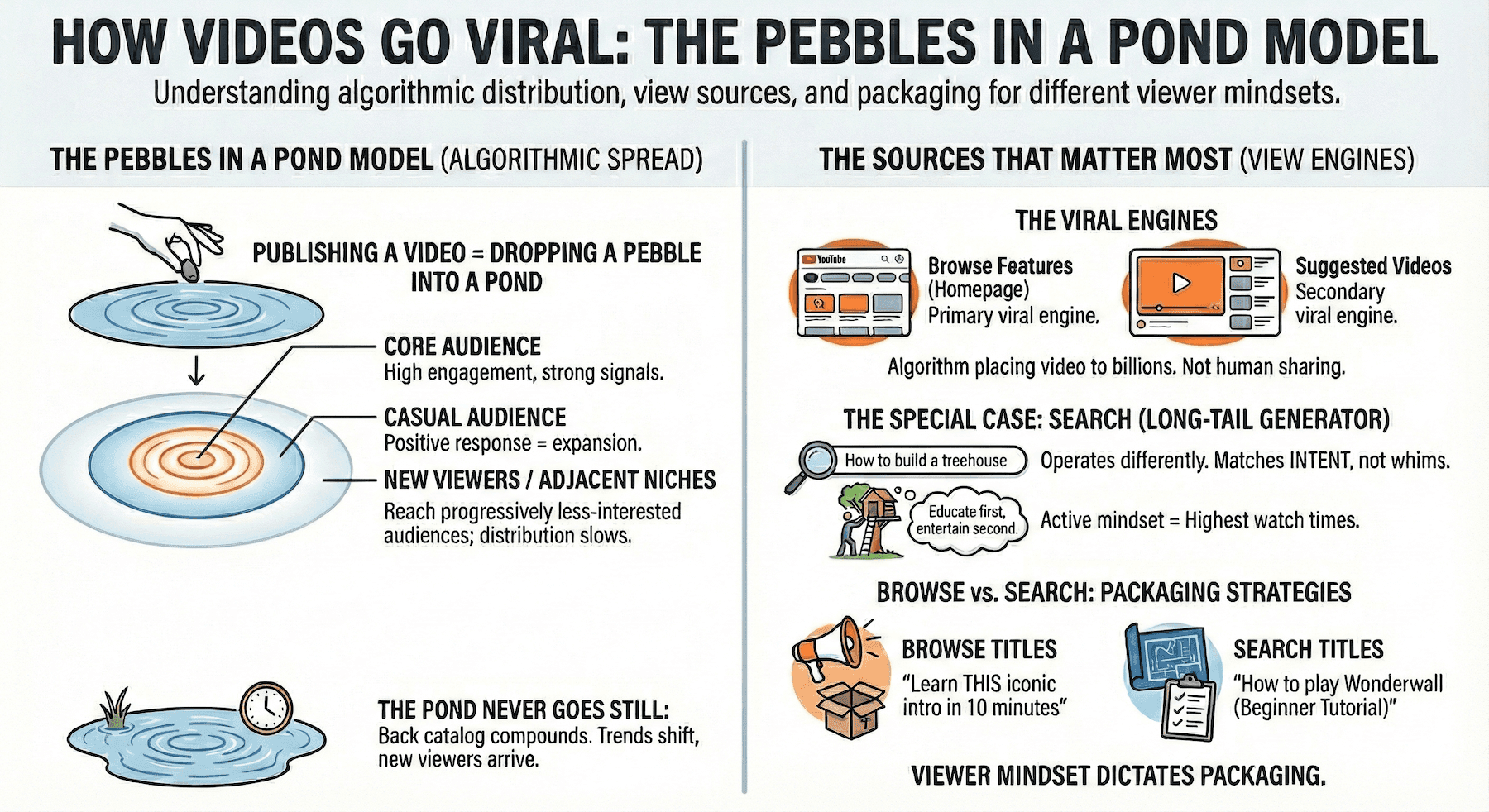
Think of publishing a video like dropping pebbles into a calm pond.
You start with small ripples—your core audience. If they watch and engage, those ripples reach your casual audience. If they respond positively, the video expands to new viewers and adjacent niches. Eventually, as ripples reach progressively less-interested audiences, they fade, and distribution slows.
You can often see this pattern in your metrics: high CTR and watch time at launch, a dip as the video spreads wider, then a rebound as YouTube learns exactly who it works for.
But here's what makes YouTube special compared to other social platforms: even when the waves settle, the pond never goes still.
Old videos keep attracting new ripples. Trends shift, new viewers arrive, search patterns change, and your back catalog quietly compounds over time.
The Sources That Matter Most
Each source of views acts like its own pebble creating ripples:
Browse Features (homepage): Your primary viral engine
Suggested Videos (next to/after other videos): Your second viral engine
Search: The long-tail generator
Other sources: Smaller but sometimes critical (more on this later)
Browse Features and Suggested Videos are your big two for "going viral"—they're the ones with the most kinetic energy. Remember, going viral isn't 1:Many anymore (humans sharing). It's 0:Many—the algorithm placing your video on 3 billion people's homepages or next to the latest MrBeast video.
The Special Case of Search: The Long Tail That Keeps Giving
Search operates differently from recommendation engines, and understanding this difference is crucial.
Picture this: You open YouTube's homepage and get pulled toward an entertaining video. But actually, you don't want to get distracted right now. You've just started building a treehouse for your kids and realized you have no idea what you're doing. So you search "how to build a treehouse" and click the first helpful-looking result.
You're in a completely different frame of mind. You're being active and intentional—you have a purpose. If the search algorithm is doing its job, it's matching your intent, not satisfying a whim like the recommendation engines do.
With search, viewers want to be educated first, entertained second—not the other way around. Because of this mindset difference, you'll often see the highest watch times from Search traffic in your Analytics.
Browse vs. Search: Different Packaging Strategies
You'll also notice successful videos are often packaged quite differently depending on whether they're optimized for Browse or Search:
Browse titles are hyperbolic, attention-grabbing, and curiosity-inducing:
"Learn THIS iconic intro in 10 minutes"
"The SECRET technique pros don't want you to know"
Search titles are descriptive and to-the-point:
"How to play Wonderwall (Beginner Tutorial) | Left & Right Hand"
"Treehouse Building for Beginners: Complete Step-by-Step Guide"
The mindset of the viewer dictates the packaging strategy.
Let's Recap: The Golden Path
Before we discuss how non-algorithmic sparks can trigger algorithmic explosions, let's consolidate what we've learned:
YouTube videos grow primarily through 0:Many algorithmic distribution via recommendations on the homepage and suggested videos. The algorithm selects and promotes videos with strong relative CTR and watch time, as these signal interest and attention—indicators that viewers will stay on the platform.
The recommendation engine tests and distributes videos among progressively differentiated audiences: first your core audience, then your casual audience, then new audiences. Over time, you might pick up a long tail of views through Search and other sources.
That's the golden path. But YouTube, like life, isn't quite that simple.
The Spark Effect: When Non-Algorithmic Goes Algorithmic
All these sources, metrics, and content types play off each other in fascinating ways.
Imagine this scenario: You're a small channel. You post your video. It gets a few views but never breaks out of your core audience—the ripples fade quickly.
Then, one of your core viewers posts your video in a subreddit dedicated to building the best treehouses in the world. Treehouse enthusiasts around the globe watch and rewatch your video, skyrocketing the watch time, likes, and shares.
Suddenly, YouTube's algorithms have all the data they need. They snap into gear and start distributing your video to 3 billion people who didn't know they wanted to build the ultimate treehouse, but now they do. Your video goes viral. The world becomes a global society of treehouse-dwelling enthusiasts.
And if that Reddit user had never posted your video, none of it would have happened.
All it takes is a ripple.
This is the power of non-algorithmic sparks. A 1:Many distribution event can generate enough signal strength to trigger 0:Many algorithmic distribution. The two types of growth aren't separate—they're deeply interconnected.
Your Growth Playbook: From Theory to Practice
Understanding the mechanics is one thing. Applying them systematically is another. Here's your actionable framework:
1. Define One Audience
Don't try to be everything to everyone. Pick a specific viewer and make content for them. The algorithm rewards focus because focused content generates strong signals from the right people.
2. Define One Promise Per Video
Each video should deliver one clear value proposition. Trying to cover too much dilutes both your packaging and your delivery.
3. Design the Click
Your title should communicate a clear outcome. Your thumbnail should provide visual proof or intrigue that supports that outcome. Together, they should make the click feel inevitable.
4. Deliver the Promise Fast
Show the result early, then teach the process. Don't bury the payoff. Viewers need to know quickly that they made the right click.
5. Engineer the Next Click
Use end screens strategically to guide viewers to the logical sequel. If someone just watched "How to Build a Treehouse Foundation," they probably want "How to Build Treehouse Walls" next.
6. Cluster Your Catalog
Create playlists and use consistent series branding. This boosts Suggested Video performance because the algorithm recognizes connected content and can build viewer sessions.
7. Ship, Learn, Iterate
Watch your traffic source mix, CTR, retention, and return viewer metrics. Improve your hooks and thumbnails first—they offer the biggest leverage points for growth.
The Compound Effect: Playing the Long Game
Here's what separates YouTube from other platforms: your content has a half-life measured in years, not days.
A video published six months ago can suddenly find its audience. A deep catalog becomes a distribution engine. Old videos attract new viewers who then discover your recent work. The pond never goes still.
Understanding these mechanics—the signals, systems, and sparks—transforms YouTube from a lottery into a systematic growth engine. You won't win with every video, but you'll know exactly why some videos work and others don't.
And that knowledge, compounded over time, is how channels grow from 3 views to 3 million.