BLOG OVERVIEW
The YouTube Channel Audit Checklist: 47 Things to Check Before You Publish Another Video
In
YouTube Audit
by
Edward Wood
Before you publish another video, run through this checklist.
If you haven't audited your channel in the past three months, the single highest-value thing you can do today is spend 90 minutes working through these 47 items.
And I know what you're thinking. 47 items?! And one of them is… hashtags?! But before you close this tab and send my bounce rate into the stratosphere, let me share two quick lessons from my two decades of marketing. First, a strategy can only achieve its full potential if the tactics are executed well. Second, a single tactic executed well and executed once will have little effect. Ten tactics executed well and executed routinely will have a huge effect.
That's why this checklist exists. It's essentially 47 tactics. Many of them only need to be executed once to ensure you've laid the best possible foundation for your channel. The others need to be executed routinely.
And yes, this is the checklist we run through on every Humble&Brag client audit. It covers six areas: channel branding and first impressions, metadata and SEO, content strategy, analytics and performance tracking, CTR and thumbnails, and audience and community. Each item includes a brief note on why it matters and, where relevant, specific benchmarks to measure against.
I'd recommend running a lightweight version of this quarterly and a comprehensive pass every six months. If you want the deeper strategic context behind each section, our complete guide to YouTube channel audits walks through the methodology in detail.
Section 1: Channel Branding and First Impressions
These are the things a new visitor sees before they watch a single video. First impressions on YouTube are formed in seconds, and a channel that looks unfinished or unfocused loses potential subscribers before any content has a chance to work.
Channel name and handle: Does the channel name clearly communicate what the channel is about? Is the handle (@yourname) clean, memorable, and consistent with your brand's presence on other platforms? If someone searches your brand name on YouTube, does your channel appear first?
Profile picture: Is it high-resolution and recognisable at small sizes? On mobile, this renders at roughly 36 pixels across. Detailed logos or text-heavy images become unreadable. A simple icon, headshot, or logomark works best.
Banner image: Does the banner communicate the channel's value proposition? The safe zone for text is roughly 1546 by 423 pixels, the area visible across all devices. Anything outside that gets cropped on mobile. Check it on your phone, not just your desktop.
Channel description: Does the about section explain who the channel is for and what they'll get from subscribing? Is it written for the viewer, not for internal stakeholders? Are relevant keywords included naturally? YouTube's search considers the channel description when deciding which channels to surface for broad queries.
Channel trailer: Do you have a trailer set for non-subscribers? Does it show your best content and make a clear case for subscribing? If your trailer is more than six months old, check whether it still represents what the channel actually publishes. At Humble&Brag, we often find the channel trailers often get surfaced via brand searches and end up driving a high volume of conversions, so it's worth spending time and thought on them.
Featured sections and playlists: Is your channel page organised into sections that help new visitors find relevant content quickly? Are playlists named with descriptive, keyword-aware titles rather than generic labels like "2025 Videos" or "Uploads"? You might be surprised how many views you can generate through playlists—and typically these views will be "high quality", meaning these views often have long average watch times. This, in turn, benefits the further algorithmic distribution of the video.
Links and contact information: Are your website, social profiles, and any lead magnets linked from the channel? YouTube allows up to five links in the banner area. Use them.
Channel keywords: Have you added channel-level keywords in YouTube Studio under Settings? These help YouTube understand your channel's topic and influence which related channels and videos yours appears alongside.
Consistency across platforms: Does the visual identity on YouTube match your website, LinkedIn, and other marketing channels? Inconsistency creates a subconscious sense of unprofessionalism that erodes trust.
Section 2: Metadata, SEO, and Discoverability
Metadata is where most channels leave the easiest gains on the table. Every video has a title, description, tags, and several other fields that influence whether YouTube's algorithm understands your content well enough to recommend it. You can easily set up and iterate upon a Claude project to help you create these almost instantaneously.
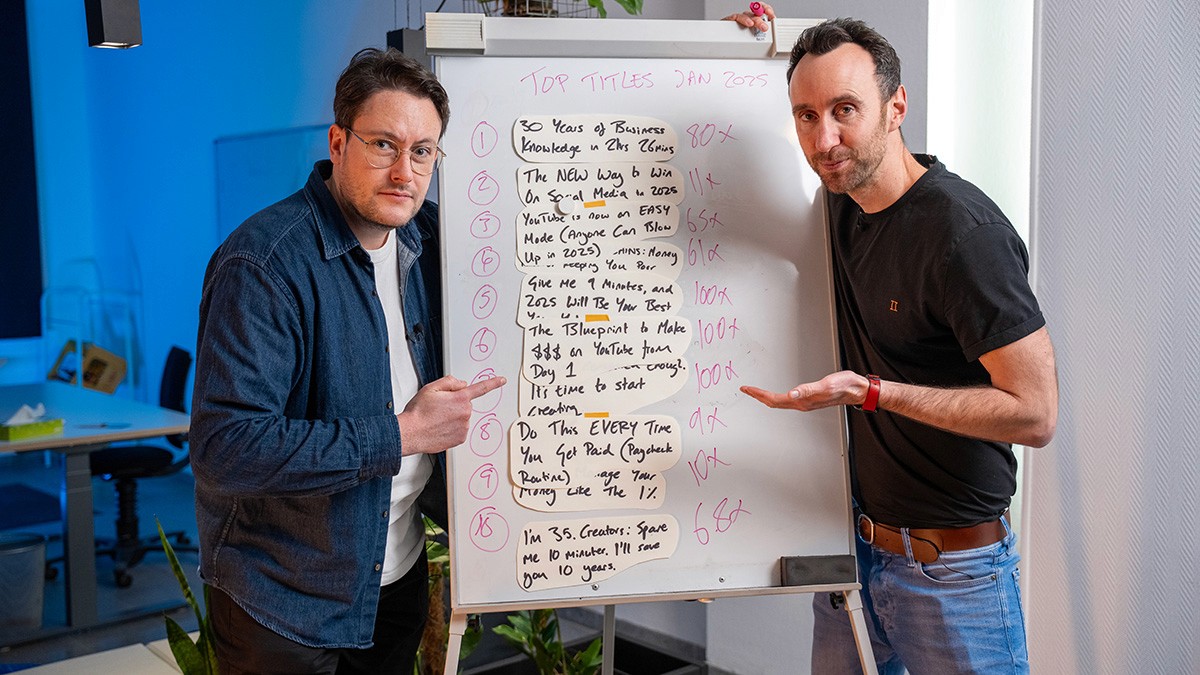
Title: Are your titles optimised for both search and click appeal? A good title includes a target keyword, communicates the video's value, and creates enough curiosity or urgency to earn the click. Front-load the most important words, as titles get truncated on mobile after roughly 55 characters. We've written detailed guides to power words and the top performing YouTube titles and their formulas if you want to go deeper.
Descriptions: Are your descriptions at least 200 words? YouTube's algorithm uses description text to understand and categorise your content. The first two lines appear in search results, so lead with value and include your primary keyword. Below the fold, include a full summary, relevant links (tagged for attribution), timestamps, and secondary keywords. We've written all about how to write the perfect description in this post—and we made a video about it too.
Tags: Does every video have relevant tags? Tags carry less weight than they used to, but they still help YouTube disambiguate topics, particularly for newer or smaller channels. Include your primary keyword, variations, and related terms. Ten to 15 well-chosen tags per video is a good target.
Chapters and timestamps: Are your longer videos (eight minutes or more) structured with chapter markers? Chapters improve viewer experience, increase the likelihood of appearing in Google's key moments feature, and provide additional SEO signal through the chapter titles themselves. If you're deploying YouTube as part of a "Search Everywhere Optimisation" strategy, I recommend you study the Google SERPs and how YouTube videos are displayed. Firstly, videos bypass Google site diversity rules, which means you can position multiple videos on the first page. Secondly, chaptered videos take up more real estate on the results page than unchaptered videos, which makes it more likely for the user to click on them.
Closed captions: Are captions accurate and complete on every video? Auto-generated captions are better than nothing, but they contain errors that can misrepresent your content to the algorithm. Editing auto-captions or uploading custom ones improves both accessibility and discoverability.
Playlist structure: Are your videos organised into playlists that reflect viewer intent rather than internal categories? Playlist titles are indexed by search, and well-structured playlists increase session watch time by auto-playing related content. Each playlist should have a keyword-rich title and a description of at least a few sentences. Once you have your playlists, don't be afraid to promote them. Link to them in your description and pinned comments to increase overall watch time on your channel.
Cards and end screens: Is every video using end screens to drive the next action, whether that's another video, a playlist, or a subscribe prompt? Are cards placed at moments where they're contextually relevant, not just dropped in randomly?
Hashtags: Are you including three to five relevant hashtags in your description? YouTube displays the first three as clickable links above the title. Use them strategically to associate your content with relevant topics or, even better, build out video series that are interlinked with hashtags.
Default upload settings: Have you configured default settings in YouTube Studio so that new uploads automatically include your standard description template, tags, and language settings? This prevents metadata from being accidentally omitted on new uploads.
Section 3: Content Strategy and Publishing
Content strategy audit items are harder to check mechanically because they require judgment. But in my experience, they're often the most important section of the audit, because strategic problems compound far more painfully than metadata gaps.
Publishing consistency: Have you published at least once per week for the past three months? Consistency is one of the strongest signals to both the algorithm and your audience. Gaps in publishing erode subscriber engagement and reduce the algorithm's willingness to recommend your content.
Topic selection methodology: Are your topics chosen based on data, such as keyword research, competitor analysis, audience demand signals, and analytics insights? Or are they based on internal brainstorming and assumptions? If you can't explain why a specific video was made, the process needs tightening. Check out the video below for a full breakdown of how to ideate videos and launch your channel.
Format testing: Have you tested at least three different content formats in the past six months? Talking head, tutorial, listicle, reaction, interview, documentary, challenge. Different formats perform differently with different audiences, and you need enough data to know what works for yours. We've covered format selection in detail in our video on YouTube formats for business growth.
Content series: Do you have at least one recurring series that viewers can follow? Series build viewing habits, improve session time, and create natural playlist structures. A channel without series is a channel without rhythm. This is probably the number one tip for 2026.
Shorts strategy: If you're publishing Shorts, are they designed to feed your long-form content? Shorts that exist in isolation might build impressions but rarely build the kind of engaged audience that drives business results. If you're looking to build a channel that drives conversion, each Short should connect to a longer video or a broader content theme.
Video length appropriateness: Are your videos the right length for the value they deliver? There's no universal ideal, but as a benchmark, if retention drops below 40 per cent before the halfway mark on most videos, they're probably too long for the depth of content they contain.
Section 4: Analytics and Performance Tracking
Analytics audit items check whether you're measuring the right things and whether the data infrastructure exists to connect YouTube performance to business outcomes.
YouTube Studio access and configuration: Does your team have proper access to YouTube Studio analytics? Are the Advanced Mode filters being used to segment data meaningfully? Many teams only use the Overview tab and miss the diagnostic depth available in Advanced Mode.
Key metric tracking: Are you regularly monitoring views, watch time, average view duration, impressions, CTR, subscriber conversion rate, and traffic source distribution? At minimum, review these weekly, and build in a regular review process to help you iterate with each release. At Humble&Brag, we do monthly retros with our clients after each batch of four videos, and prioritise action points for the next rounds of ideation, production, and edits.
Retention analysis: Do you review retention curves for every video published? Retention data is the most valuable signal YouTube Studio provides. If you're not reviewing it, you're flying blind. As I explain in the video below, you can obtain a remarkable level of detail from the graphs within YouTube Studio.
Traffic source distribution: What percentage of views come from browse features, YouTube search, suggested videos, and external sources? A healthy channel has multiple active traffic sources. Over-reliance on any single source means you're probably missing a trick. For example, browse features often drives peaks of growth but a lot of volatility and unpredictability, while Search often drives slow but resilient and predictable growth. The most robust channels have a good mix, typically with these two as the cornerstones.
Revenue and conversion attribution: Can you trace a path from video view to business outcome? Are your description links tagged with UTM parameters or other tracking? Is there a self-reported attribution question in your sign-up or contact flow? Without attribution, you cannot prove YouTube's value to the business, and channels that can't prove their value eventually lose their budget.
Benchmarking against historical performance: Are you comparing current performance to the previous quarter, not just to the previous week? Short-term fluctuations are noise. Quarterly trends are signal. If average view duration has declined 10 per cent quarter over quarter, that's a problem worth investigating even if individual videos are performing acceptably.
Competitor benchmarking: Do you regularly review competitor channels' performance? SocialBlade provides free estimates of subscriber growth and view trends. For a deeper methodology, our guide to YouTube competitor channel analysis covers the full framework.
Section 5: CTR, Thumbnails, and Titles
Click-through rate is where creative quality meets data. Small improvements in CTR compound into significantly more views, because a higher CTR signals to the algorithm that your content deserves broader distribution.
Impressions-to-CTR ratio: What is your channel's average CTR across all traffic sources? As a (very) rough benchmark, below 3 per cent from browse features suggests your thumbnails and titles need work. Between 4 and 7 per cent is solid for most niches. Above 8 per cent is exceptional. These benchmarks shift depending on your mix of sources, niche and audience size, but they provide a useful starting point. To really get a hold of this data though, you need to dig. Drill down to the source level and monitor CTR for the high impression channels, like Browse Features and Suggested Videos.
Thumbnail visual clarity: Do your thumbnails read clearly at the size of a postage stamp? Open YouTube on your phone and scroll through your channel. If you can't immediately understand what any thumbnail is communicating, it needs a redesign.
Thumbnail consistency: Does your channel have a recognisable visual style across thumbnails? Brand consistency helps returning viewers spot your content in a crowded feed. That doesn't mean every thumbnail should look identical, but there should be a recognisable family resemblance.
Title-thumbnail alignment: Do each video's title and thumbnail work together as a pair, or are they redundant? The thumbnail should show something the title doesn't say. Together, they should create a stronger case for clicking than either could alone.
A/B testing: Are you using YouTube's thumbnail test feature? If it's available on your channel, test every new upload. Even small CTR improvements, a fraction of a percentage point, translate into meaningful view increases at scale. Not only that, if you document results, you'll quickly begin to recognise patterns and heuristics that work for you and your channel.
Low-CTR video audit: Have you identified videos with high impressions but low CTR? These are your highest-leverage optimisation targets. A title and thumbnail refresh on a video that's already getting impressions can unlock growth without publishing anything new.
Section 6: Audience and Community
The final section assesses whether you're building a real audience or just accumulating views.
Subscriber-to-view ratio: What percentage of your views come from subscribers versus non-subscribers? A very low subscriber share (under 20 per cent) suggests your content reaches new people but doesn't convert them into followers. A very high subscriber share (over 70 per cent) suggests you're not reaching enough new viewers.
Comment quality and volume: Are people leaving substantive comments, or is the section empty or filled with spam? Healthy comment sections signal to the algorithm that your content generates engagement, and they provide direct feedback on what your audience values.
Comment management: Are you responding to comments within 24 hours of publishing? The first few hours after upload are when engagement signals matter most. Active comment management during this window can measurably improve a video's algorithmic performance.
Community tab usage: If available, are you using the community tab to engage subscribers between uploads? Polls, behind-the-scenes images, and discussion posts maintain visibility in subscribers' feeds and provide lightweight engagement signals.
Audience demographics alignment: Do the demographics in your YouTube analytics match your target customer profile? If your content is reaching the wrong age group, geography, or interest segment, you have a targeting problem that no amount of optimisation will fix.
Subscriber notification rate: What percentage of your subscribers have notifications enabled? A very low rate suggests that people subscribe but don't value the content enough to be notified about it, which is a content quality or relevance signal worth investigating.
What to Do After Running This Checklist
Don't try to fix everything at once. Sort your findings into three buckets. Quick wins are items you can fix in under an hour per video: metadata gaps, missing tags, broken links, incomplete descriptions. Do these first. Medium-term improvements are items that require new content or creative work: thumbnail refreshes, format experiments, series development. Plan these into your content calendar for the next quarter. Strategic shifts are positioning changes, audience targeting adjustments, or business integration work that requires cross-functional coordination. Schedule these as projects with clear owners and deadlines.
If this checklist has surfaced more problems than you can address alone, that's normal. It's also exactly what we do. Every Humble&Brag client engagement begins with this audit, and the action plan that comes out of it is part of what shapes the first three months of strategy. If you want us to run it for your channel, let's talk.