BLOG OVERVIEW
The Best YouTube Title Formulas in 2026: What's Actually Getting Clicked
In
YouTube
by
Edward Wood
At Humble&Brag, we have a tool that lets us analyse thousands of YouTube titles by their outlier performance: how many times more views a video received compared to the channel's average. We use it when developing title strategy for clients, and it consistently reveals the same thing: the titles that outperform by 10x, 50x, or even 100x aren't random. They follow recognisable formulas.
This article breaks down the best-performing YouTube title formulas of 2026 based on that data. Not theory. Not "10 tips for better titles." Actual performance analysis from real videos, showing which structural patterns earn disproportionate clicks across niches.
If you'd a more light-hearted rundown, check out our quiz show below 👇
And if you want the underlying principles behind these formulas, including character length, keyword placement, and A/B testing methodology, our companion guide on YouTube title best practices covers the rules. This article covers the patterns.
The Top-Performing Titles of 2026 (And Their Outlier Scores)
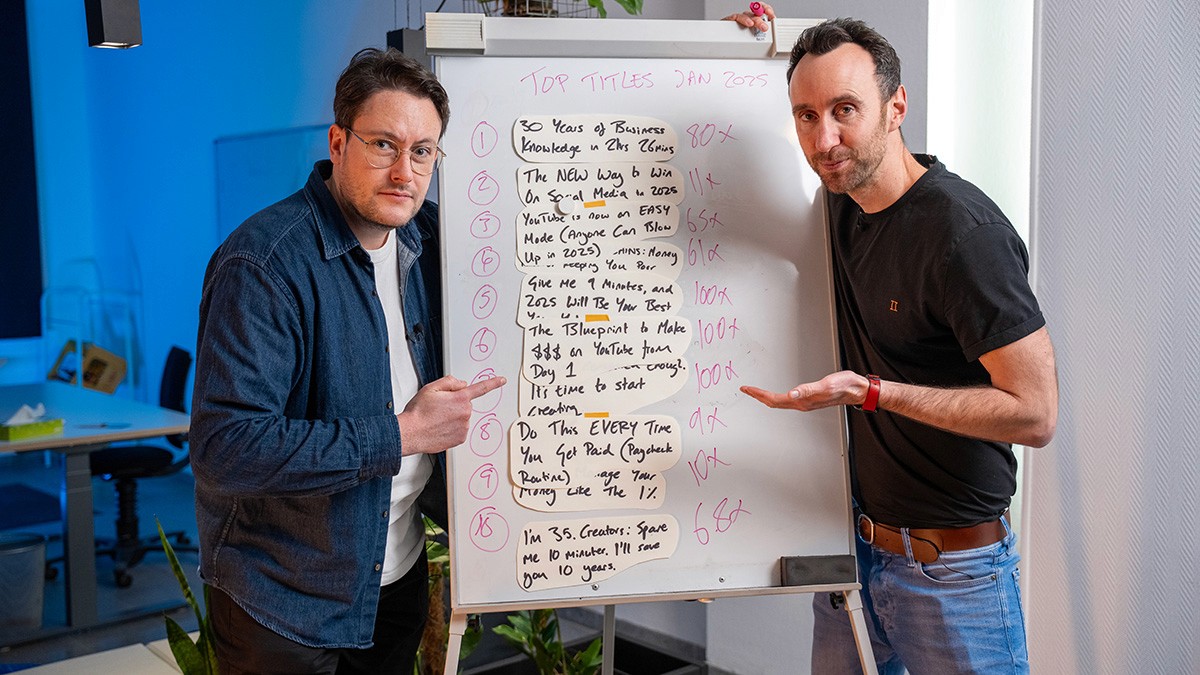
We analysed hundreds of top-performing videos across business, education, finance, and creator channels using VidIQ's outlier scoring to identify titles that significantly outperformed their channel's baseline. Here are ten that stood out, along with what made each one work.
Rank | Title | VidIQ Multiplier | Why It Worked |
|---|---|---|---|
1 | The Blueprint to Make $$$ on YouTube from Day 1 | 100x | “Blueprint” signals a proven plan. “From Day 1” lowers the barrier. Combined, it promises fast results with low friction. |
2 | Give Me 9 Minutes, and 2025 Will Be Your Best Year Yet | 100x | Plays on specificity + high reward for low investment. Also borrows language from time-tested ad formulas. |
3 | You've Consumed Enough. It’s Time to Start Creating. | 100x | A motivational push with identity language. Speaks directly to the creator archetype. |
4 | 30 Years of Business Knowledge in 2hrs 26mins | 80x | Huge payoff in a compressed timeframe. Easy to skim, hard to ignore. |
5 | YouTube is now on EASY Mode (Anyone Can Blow Up in 2025) | 65x | “Easy Mode” is the power word doing the heavy lifting. Paired with a broad, timely promise. |
6 | ACCOUNTANT EXPLAINS: Money Habits Keeping You Poor | 61x | Authority upfront + pain point. Caps lock adds urgency and signals expert clarity. |
7 | The NEW Way to Win on Social Media in 2024 | 11x | Leverages novelty. “Way to win” taps into status, relevance, and growth. |
8 | How to Manage Your Money Like The 1% | 10x | Subtle aspiration. “Like the 1%” implies access to a secret system. |
9 | Do This EVERY Time You Get Paid (Paycheck Routine) | 9x | Highly actionable. “Every time” suggests a habit worth adopting. |
10 | I’m 35. Creators: Spare Me 10 Minutes, I’ll Save You 10 Years | 6.8x | Combines relatability with authority. Also uses a high-yield structure: “Give me X, I’ll give you Y.” |
"The Blueprint to Make $$$ on YouTube from Day 1" delivered a 100x outlier score. "Blueprint" signals a proven, replicable system, and "From Day 1" lowers the perceived barrier to entry. Together, they promise fast results with low friction, which is the exact combination that earns clicks.
"Give Me 9 Minutes, and 2025 Will Be Your Best Year Yet" also hit 100x. The specificity of "9 minutes" does the heavy lifting here. It tells the viewer exactly what the time commitment is, which makes the promise feel honest rather than inflated. This formula borrows directly from classic direct-response advertising, and it still works because the psychology hasn't changed.
"You've Consumed Enough. It's Time to Start Creating." reached 100x through a completely different mechanism: identity language. This title challenges the viewer's self-image. It positions clicking as an act of self-improvement rather than passive consumption. Titles that make the viewer feel something about themselves, rather than promising information, consistently outperform in our data.
"30 Years of Business Knowledge in 2hrs 26mins" achieved 80x by compressing an enormous amount of value into a specific, believable timeframe. The precision of "2hrs 26mins" is deliberate. Rounded numbers feel like estimates. Precise numbers feel like measurements. That distinction matters for perceived credibility.
"YouTube is now on EASY Mode (Anyone Can Blow Up in 2025)" hit 65x. "Easy Mode" is the phrase doing the work. It's borrowed from gaming language, which immediately signals accessibility and low difficulty. The parenthetical broadens the promise to anyone, removing the "but is this for me?" hesitation.
Further down the list, "ACCOUNTANT EXPLAINS: Money Habits Keeping You Poor" scored 61x by leading with authority. The professional title in caps establishes instant credibility, and the pain point ("Keeping You Poor") creates urgency. "The NEW Way to Win on Social Media" hit 11x by leveraging novelty, which both YouTube's algorithm and human psychology consistently reward. And "I'm 35. Creators: Spare Me 10 Minutes, I'll Save You 10 Years" scored 6.8x through what I'd call the mentor structure: a slightly older, slightly further-along creator offering a concentrated dose of hard-won wisdom.
The Five Formulas That Keep Appearing
Across thousands of high-performing titles, the same structural patterns appear repeatedly. Not every great title fits neatly into one of these, but the vast majority draw from at least one.
1. The Compression Formula
Structure: [Large value] in [Small time or effort]
This is the single most reliable title formula in our data. "30 Years in 30 Minutes." "Everything I Learned About SEO in One Video." "12 Sales Tips in 60 Seconds." The formula works because it promises density. The viewer gets maximum return for minimum investment, and the specificity of the timeframe makes the promise feel credible rather than vague.
The compression formula is particularly effective for business and educational content because professional audiences are time-constrained and value efficiency. At Babbel, our highest-performing YouTube titles were almost always compression-structured: "Learn German in 20 Minutes" outperformed "German for Beginners" by a wide margin, even though both targeted the same audience.
When using this formula, precision matters. "Get More Subscribers Fast" is weak. "Get 1,000 Subscribers in 7 Days (Without Ads)" is strong. The specific numbers create a mental contract between the title and the viewer.
2. The Blueprint Formula
Structure: My [System/Blueprint/Framework] for [Specific Result]
"Blueprint," "formula," "framework," "playbook." These words all signal the same thing: there's a replicable system behind the result, and the viewer is about to be given access to it. This formula taps into the desire for a shortcut that feels legitimate rather than gimmicky.
The key to making this formula work is pairing the system word with a concrete, specific outcome. "My Blueprint for YouTube Growth" is generic. "My Full Blueprint for Scaling to 100K Subs" is specific. The specificity transforms the title from a promise into a preview.
We use this formula frequently for client channels, particularly in B2B where the audience responds to structured, methodical approaches. A title like "The Framework We Use for Every Channel Audit" performs well because the B2B buyer wants systems, not inspiration.
3. The Identity Formula
Structure: [Statement about the viewer's identity] + [Challenge or transformation]
"You've Consumed Enough. It's Time to Start Creating." "Still Editing Videos Yourself? Here's Why That's Costing You." "If You're 25 and Creating, Watch This First."
These titles don't promise information. They promise transformation, or at least a confrontation with the viewer's current state. They work because they're personal. The viewer sees themselves in the title, and that recognition creates an emotional response that earns the click far more reliably than a list of benefits.
First-person variants of this formula ("I'm 35. Spare Me 10 Minutes, I'll Save You 10 Years") add a mentorship dynamic. The creator positions themselves as someone slightly ahead on the same path, which builds trust and curiosity simultaneously. Research from Backlinko confirms that titles using personal pronouns ("I" and "you") consistently achieve higher CTR than impersonal alternatives.
4. The Authority Formula
Structure: [Professional credential] + [Specific claim]
"ACCOUNTANT EXPLAINS: Money Habits Keeping You Poor." "Former Google Engineer Reveals How Search Actually Works." "I'm a Former Ad Exec. Do THIS Before You Launch."
Authority-led titles work because they answer the viewer's first question before they even ask it: "Why should I listen to this person?" By leading with the credential, the title earns credibility immediately. This is especially powerful in niches where trust is the primary barrier to engagement: finance, health, law, marketing, and B2B.
The capitalisation of the credential ("ACCOUNTANT EXPLAINS") is a deliberate formatting choice. On YouTube, selective capitalisation of one or two words adds visual emphasis without crossing into the all-caps territory that feels like spam. Our guide on power words for YouTube titles covers the specific language choices that amplify this formula.
5. The Novelty Formula
Structure: The [NEW/2026/Updated] way to [Achieve Result]
"The NEW Way to Win on Social Media." "The 2026 Strategy You Haven't Tried." "Forget Hooks. Try This Instead."
Novelty works because YouTube's recommendation algorithm and human psychology both reward it. The algorithm surfaces fresh content for trending and time-sensitive queries. Human brains are wired to attend to novel stimuli over familiar ones. Combining both signals creates a title that performs well in both search and browse.
The risk with novelty titles is a short shelf life. A title containing "2025" starts feeling dated by early 2026. Evergreen titles that avoid year-specific language tend to compound views over time, while novelty titles spike and decay. For most business channels, I recommend using the novelty formula sparingly, perhaps one in every five or six videos, and relying on compression and blueprint formulas for the library's evergreen core.
How We Use These Formulas at Humble&Brag
When we develop title strategy for clients, we don't start with formulas. We start with data. Our proprietary title research tool analyses thousands of videos across a client's niche, identifying outlier performers and extracting the structural patterns that drove their success. We look at what's working within the niche (topic-focused matches), what's working across niches (cross-niche pattern matches), and which specific language patterns, emotional triggers, and authority signals correlate with outsized performance.
The formulas above are the output of that analysis. They're patterns, not prescriptions. A compression title that works brilliantly for a personal finance channel might fall flat for an enterprise SaaS channel, because the audiences have different expectations, different attention thresholds, and different relationships with time-based promises. The formula is the starting point. The audience context is what makes it work.
We also test aggressively. YouTube's built-in thumbnail and title testing allows you to A/B test title variations on live videos, and the data it produces is among the most valuable in the entire analytics suite. Every client channel we manage runs continuous title tests, because even small CTR improvements compound into significant view increases at scale. For the details on how to run these tests, see our guide on writing clickbait YouTube titles that actually perform.
The Shorts Title Difference
YouTube Shorts titles follow different rules. Because Shorts are consumed through a swipe-based feed rather than a search-or-click model, the title functions more like a caption than a headline. Viewers don't choose a Short based on its title; they discover it in the feed and the title provides context for what they're already watching.
For Shorts, the most effective title patterns in our data are short declarative statements (under 40 characters), hook repetitions that echo the video's opening line, and curiosity-gap phrases that encourage the viewer to watch to the end. The compression and blueprint formulas that dominate long-form titles don't transfer well to Shorts because the value proposition is different: Shorts promise a moment, not a system.
What a Title Can't Do
A strong title earns the click. It can't keep the viewer watching, and it can't compensate for weak content. The worst thing you can do on YouTube is write a title that overpromises and underdelivers, because the algorithm now measures viewer satisfaction directly. A high CTR followed by early abandonment is a net negative signal, as we explained in our analysis of what makes YouTube videos go viral and the "good abandonment" metric that now governs how YouTube evaluates content quality.
The best title formula is one that accurately previews a genuinely valuable video. If the content delivers on the promise, the title did its job. If the content doesn't, no formula will save it.
If you're looking for help developing a title strategy grounded in data rather than guesswork, or if you want to see how our title research tool can identify the patterns working in your niche, let's talk.