Remember when growing on YouTube just meant posting consistently and hoping for the best?
Those days are ancient history.
In 2026, YouTube has evolved into one of the most sophisticated media ecosystems on the planet. It's where creators build nine-figure empires, where brands compete head-to-head with Netflix for viewer attention, and where a single strategic decision about topic selection or thumbnail design can translate into millions of views and substantial revenue.
This evolution has given rise to a new breed of specialist: the YouTube strategist. These are the architects working behind the scenes, engineering growth and transforming YouTube from a creative gamble into a repeatable, scalable system.
This guide breaks down the thirteen best YouTube strategists working today, explains what actually sets them apart, and shows you why each one matters whether you're a creator building an audience, a brand investing in video, or an entrepreneur scaling a YouTube business.
What Actually Defines a "Top" YouTube Strategist in 2026?
Before we dive into specific names, let's establish what doesn't qualify someone for this list.
This isn't about who has the biggest personal following, who posts the loudest takes on social media, or who rehashes the same generic growth tips everyone's heard before.
The strategists featured here have earned their reputation through tangible outcomes: channels scaled to massive audiences, systems that work across multiple niches, clear strategic philosophies backed by results, and genuine influence on how YouTube is professionally managed today.
Some maintain high public profiles. Others deliberately stay behind the camera. All of them fundamentally shape how YouTube works in 2026.
1. Derral Eves: The Algorithm Architect
If YouTube strategy had a founding father, Derral Eves would hold that title.
Eves is best known for his deep understanding of how YouTube's algorithm evaluates content at scale. His work on projects generating tens of billions of views, his role producing The Chosen (one of the most successful crowdfunded media projects in history), and his founding of VidSummit—arguably the most influential YouTube conference globally—have cemented his position as an industry titan.
What separates Eves from tactical advisors is his systems thinking approach. He views YouTube as an interconnected ecosystem where discovery mechanics, audience velocity, monetization pathways, and viewer psychology work together. His strategies consistently favor long-term leverage over short-term spikes, which explains why his clients build sustainable, resilient channels rather than flash-in-the-pan successes.
If you want to understand why YouTube rewards certain creator behaviors rather than just learning what tactics to deploy, Eves represents where modern YouTube strategy begins.
2. Tim Schmoyer: The Creator-First Strategist
Tim Schmoyer has been actively shaping YouTube longer than almost anyone still working in the space today.
Through Video Creators, he's helped channels accumulate over twenty billion views, worked with major studios including Disney and HBO, and coached thousands of creators through sustainable growth journeys.
Schmoyer's distinguishing characteristic is his creator-first philosophy. While many strategists optimize purely for clicks and viral moments, Schmoyer focuses on building audience trust, maintaining retention over time, and nurturing community health. His work consistently answers one essential question: how do you grow without burning out or hollowing out the audience relationship?
That's why his frameworks remain highly relevant in 2026, particularly for educational channels, media companies, and mission-driven organizations where audience quality matters as much as audience size.
3. Matt Gielen: The Data-Driven Programmer
If YouTube were television, Matt Gielen would be the programming executive everyone wanted to hire.
Often described as the world's foremost YouTube strategist, Gielen built massive channel portfolios for Viacom, Netflix, and MovieClips before founding Little Monster, which was later acquired by Electric Monster.
His edge lies in programming strategy: determining what formats to run, how frequently to publish, in what sequence to release content, and for which specific audience segments. Gielen treats YouTube like a sophisticated media network rather than a social feed. His approach is deeply analytical—analyzing retention curves, testing click-through rates, mapping audience overlap—and designed specifically for scale.
For brands or publishers treating YouTube as a serious media channel rather than an afterthought, Gielen's methodology is foundational.
4. Paddy Galloway: The Packaging & Ideation Specialist
Paddy Galloway operates at the sharp end of YouTube performance, where execution quality meets strategic insight.
His clients collectively generate hundreds of millions of views monthly, and he's frequently cited by top creators themselves as the strategist who helped unlock their next growth level.
Galloway's particular strength lies in idea selection and packaging strategy. He's obsessed with understanding why certain topics win, why specific thumbnails get clicked, and why one framing approach can outperform another by tenfold.
In 2026, when execution quality has become table stakes across the platform, ideation and packaging often represent the real bottleneck to growth. That's where Galloway's work creates disproportionate impact for his clients.
5. Seb Losardo: The Professionalizer
Seb Losardo represents one of the clearest examples of YouTube's evolution from "creator economy" to legitimate media industry.
He built Sky Sports' YouTube channel from zero to over ten million subscribers, and now advises elite creators and organizations on running YouTube operations like production companies rather than hobbyist projects.
Losardo maintains ruthless focus on fundamentals: titles and thumbnails matter more than production value, the first two minutes matter more than the final ten, and systems consistently beat raw talent over time.
His philosophy—creative engineering over guesswork—has quietly influenced how many top-performing channels now operate behind the scenes.
6. Nick Nimmin: The Growth Educator
Nick Nimmin often serves as the first strategist people encounter when they start taking YouTube seriously, and for good reason.
He's built a nearly million-subscriber channel teaching YouTube growth fundamentals, tools, and optimization techniques. His advice consistently proves practical, accessible, and grounded in real experience rather than theory.
What sets Nimmin apart is translation. He takes complex platform mechanics and converts them into actionable guidance specifically for smaller creators and early-stage channels. In an ecosystem dominated by extremes—MrBeast-scale advice on one end, generic tips on the other—Nimmin's role filling that middle ground remains valuable.
7. Sunny Lenarduzzi: The Funnel Strategist
Sunny Lenarduzzi approaches YouTube through a fundamentally different lens: conversion optimization.
Rather than optimizing primarily for AdSense revenue or sponsorship deals, her work focuses on converting viewers into subscribers, leads, and paying customers. Her Authority Accelerator program has helped thousands of entrepreneurs build YouTube-driven businesses with clear commercial outcomes.
In 2026, when brand channels increasingly struggle to justify YouTube ROI to leadership teams, Lenarduzzi's funnel-first approach has become more relevant than ever.
Her contribution isn't about creating viral moments. It's about establishing commercial clarity and building sustainable business models around YouTube content.
8. Safwaan Mohammed: The Retention Strategist (Behind the Scenes)
Safwaan Mohammed deliberately maintains a low profile, but his influence on modern YouTube strategy is substantial.
He works behind the scenes with creators like Ali Abdaal and Daniel Priestley, focusing obsessively on retention mechanics—identifying where viewers drop off, understanding why they leave, and optimizing how structure and editing affect watch time.
One of his most frequently quoted principles: real breakthroughs often emerge after three hundred to four hundred uploads, not after a handful of videos.
In a world obsessed with growth hacks and shortcuts, Mohammed's work serves as a reminder that YouTube still fundamentally rewards mastery of core fundamentals executed relentlessly over time.
9. Jamie Whiffen: The Hook & Packaging Engineer
Jamie Whiffen represents a newer generation of strategists specializing in front-loaded performance optimization.
He's known for developing frameworks like PVSS (Proof, Value, Structure, Stakes), designed to dramatically improve retention in the critical first thirty seconds—often the make-or-break metric for modern YouTube videos.
Whiffen works with creators including Ali Abdaal and Simon Squibb, and his focus remains laser-sharp: if you lose viewers in the opening moments, nothing else about your video matters.
In 2026, where viewer attention has become brutally scarce, this particular skillset proves increasingly decisive for channel performance.
10. Jamie Rawsthorne: The Viral Reverse Engineer
Jamie Rawsthorne built his reputation doing something most strategists discuss but few actually execute: systematically reverse-engineering virality at scale.
After co-founding the Zac & Jay Show and growing it to nearly a million subscribers, he transitioned into strategy work, helping creators like Codie Sanchez scale through what he calls the YouTube Views Machine methodology.
His approach blends competitive analysis, idea extrapolation, and pattern recognition across different niches to identify high-potential content opportunities.
For creators prioritizing scale over brand polish, Rawsthorne's methods provide a powerful shortcut to understanding what works and why.
11. Callum McIntyre: The Data-Led Operator
Callum McIntyre represents the rise of the operator-strategist—someone who combines strategic thinking with operational excellence.
After leading production at some of the world's most-watched automotive channels, he founded Channel Velocity, bringing highly structured, data-led approaches to ideation, retention optimization, and execution.
His philosophy has evolved beyond simple outlier copying. In 2026, McIntyre actively advocates for the limits of pure imitation and emphasizes the growing importance of original ideation informed by analytics rather than dictated by data alone.
For advanced creators building sophisticated content operations, that distinction makes all the difference.
12. Edward Wood: The Business Strategist
Edward Wood's contribution to YouTube strategy sits at the critical intersection of media and business outcomes.
With a background leading content at Babbel—where he managed teams of thirty people responsible for channels generating roughly a quarter of the company's nine-figure revenue—and later serving as CMO at CareerFoundry during a period of fifteen-times revenue growth, Wood brings a perspective grounded in real business impact rather than vanity metrics.
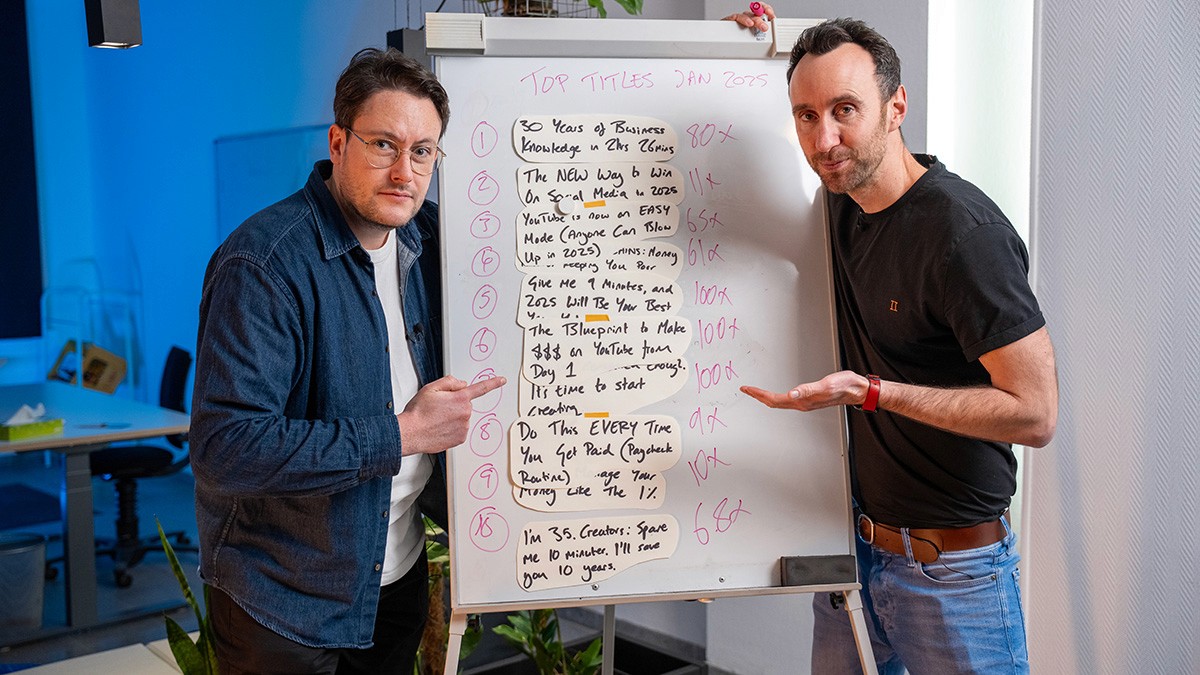
At Humble&Brag, the agency he co-founded with Calum Russell, Wood consistently argues that YouTube shouldn't exist as an isolated channel but rather as a growth engine deeply embedded in a company's broader marketing strategy.
His work focuses on positioning YouTube channels with clear strategic intent, aligning content with specific commercial outcomes, and building long-term audience equity rather than chasing algorithmic trends.
For startups and scale-ups in 2026, this business-first framing often makes the difference between producing "nice content" and driving measurable impact on company growth.
13. Calum Russell: The Systems Builder
If Edward Wood provides strategic direction, Calum Russell builds the operational machinery that makes it work.
Russell scaled CareerFoundry's YouTube channel from sixteen thousand to over two hundred fifty-five thousand subscribers, transforming it into a lead generation engine producing millions in attributed revenue annually through repeatable systems: strategic batching, niche focus, packaging discipline, and distribution strategy.
His particular strength lies in execution at scale. In a landscape where many channels fail not because of poor ideas but because of inconsistent delivery, Calum's operational mindset proves increasingly valuable—especially for teams rather than solo creators.
At Humble&Brag, Calum focuses on building the production systems, content workflows, and quality control processes that allow companies to treat YouTube as a reliable, predictable growth channel rather than a creative experiment.
The Real Lesson: There Is No Single "Best" YouTube Strategist
What this analysis should make clear is that no single "best" YouTube strategist exists—only the right strategist for your specific challenge.
Different specialists excel at different aspects of YouTube success. Some focus on algorithmic understanding and platform mechanics. Others specialize in retention psychology and viewer behavior. Some excel at packaging and ideation. Others bring business strategy and commercial alignment. Still others build operational systems and execution frameworks.
The smartest creators and companies in 2026 don't search for magic bullets or silver-bullet solutions. Instead, they build strategic capability by learning from multiple perspectives on this list and synthesizing those insights into approaches that fit their unique context, goals, and constraints.
That synthesis—combining algorithmic understanding with business strategy, packaging excellence with retention mechanics, creative vision with operational discipline—is what modern YouTube success actually looks like in practice.