BLOG OVERVIEW
AI SEO Automation: How We Drove 149× Blog Impressions
In
Claude for Business
by
Edward Wood
I'm Ed, co-founder of Humble&Brag, a full-stack YouTube agency for startups. Over the last year I've gone from opening ChatGPT once or twice a week to running Claude on pretty much every piece of work we do. The single biggest change from that has been how we handle SEO. AI SEO automation has grown our blog traffic faster than anything else we've tried, and this article is the honest account of how, with our own numbers rather than a borrowed theory.
To use AI for SEO, run it as a system rather than a writing shortcut. Point it at your Search Console and Ahrefs data to find question gaps, have it draft the article in your own voice with your own data, push that draft to your CMS, then a person reviews and publishes. Automation finds and drafts; people approve.
The growth curve
The graph below plots organic search impressions on a log scale, indexed so the shape is what matters and the real figures stay private. It carries two independent blogs running the same YouTube-First SEO system. One is our own agency blog. The other is an AI-education client whose blog sat almost flat for a year, barely moving, then bent sharply upward the month the system went live. Two different sites, two different niches, the same inflection once the workflow was switched on.
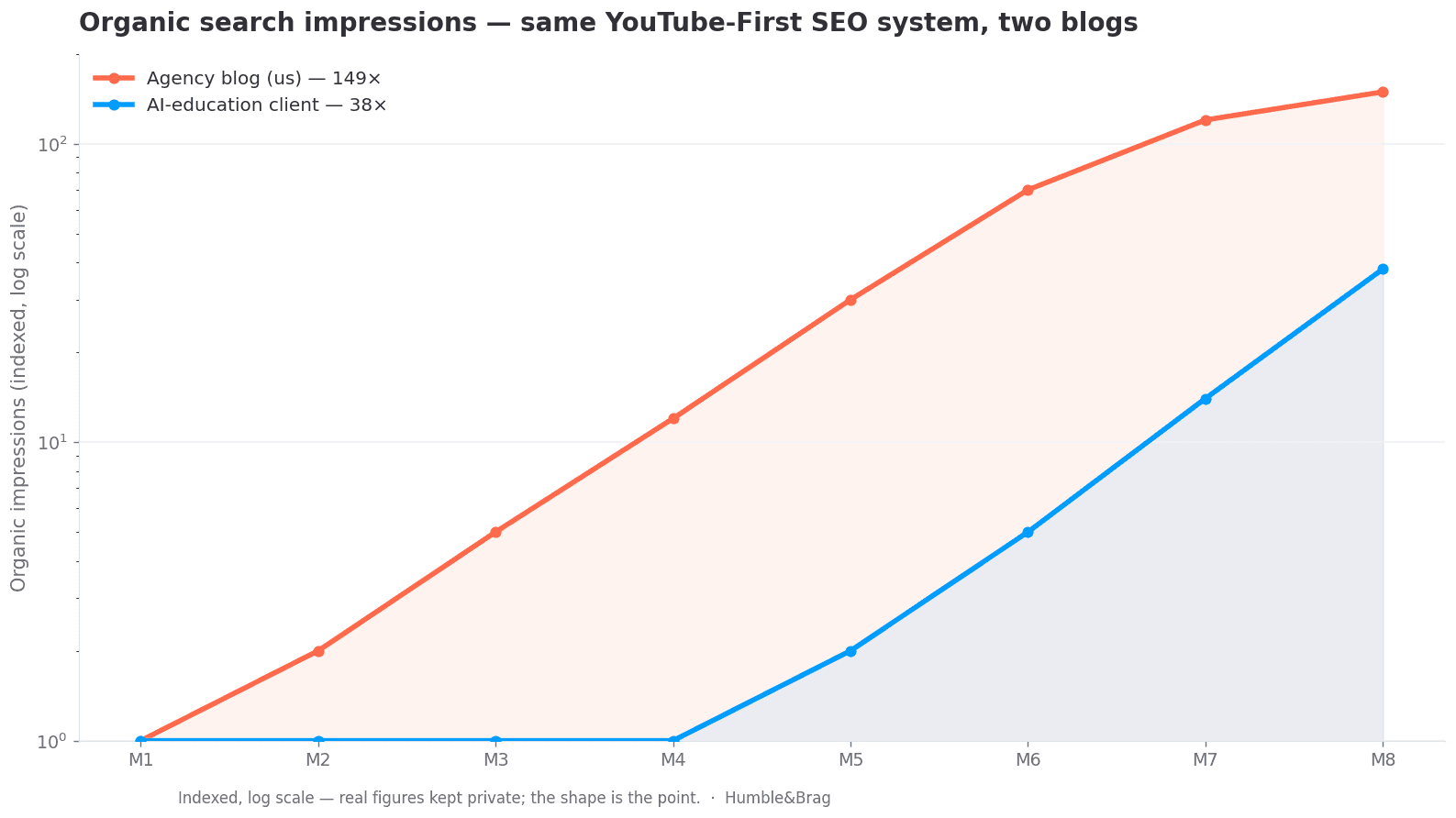
Our own line is the headline number: a 149× increase in organic impressions over seven months, from a genuinely low base. I want to be straight about that base. We started small, so a large multiple is easier to post than it would be from an established position. What the multiple shows is not that we're enormous, but that the direction changed and held. We hit record traffic pretty much every single week now, which is not a sentence I could have written a year ago.
The 149× figure is ours, measured on our own property, and I'd rather you treat it as a real result from one agency than a benchmark for your account. Your base, niche and starting authority will move the number. The pattern, though, is the point: flat, then up and to the right, once the system replaces the ad-hoc.
The system: gap to draft to publish
We're not really writing blog posts anymore. We're running a system that finds the gap, drafts an article, and pushes it to our CMS, and our job is to manage the overarching strategy.
Here is the loop, start to finish. It reads Search Console and Ahrefs to surface the topics most likely to win for us: a query we're already showing up for on page two, or a question in Ahrefs that nobody has answered properly. From that gap it writes a brief, then drafts the article using the same frameworks and original scripts we use on YouTube, so the voice stays consistent and the proprietary data and anecdotes are baked in. The finished draft is pushed automatically into our CMS in draft mode. The last step is a human one: Calum or I read it, check it, and press publish.
That draft-mode handoff is the load-bearing part. Nothing reaches the live site without a person reading it first. The machine does the finding and the drafting, which is most of the labour. We keep the judgement, the final edit, and the decision to publish. If you want to see where the same discipline applies to video, our YouTube SEO audit walks through the equivalent checks on a channel.
The connectors doing the work
The system is only as good as the data feeding it, so it helps to name what each connector actually contributes.
Search Console is the honesty layer. It shows the queries you're already ranking for but not winning, the near-misses sitting in positions eight to fifteen where a better page would move you onto page one. Those are the cheapest wins available, and they're invisible without it.
Ahrefs is the opportunity layer. It surfaces questions with real search demand and shows how thin the existing answers are, which is how we tell a gap worth filling from a crowded fight not worth picking.
The YouTube API and vidIQ tie the blog back to the video work. Because we're a YouTube-first agency, a lot of our best material already exists as scripts and transcripts. Those connectors let the system pull the topics, framings and performance signals from the channel and reuse them on the blog, so the two halves reinforce each other instead of running as separate content efforts.
Technical SEO matters here too, more than it used to. Schema markup, structured data and core web vitals carry extra weight in the age of AI search, because the engines lean on structured data heavily when they decide what to pull into an answer. Using Claude in Chrome and Claude Code, the agent looks at how competitors structure their schema, checks it against Google's guidance, and we adapt it in Framer. We saw record traffic the day we implemented it, though it's early to draw a firm line from that alone. If you're setting this up for video pages, our guide to video schema markup covers the specifics.
Why the economics flipped
There has always been a long tail of articles you'd love to write but never do. You spot a keyword in Search Console, or a question in Ahrefs nobody has answered well, and it's genuinely useful, but the search volume is too low to justify the production cost. So it never gets briefed, and it never gets done.
This workflow changes that sum, because the cost of producing a good article has dropped so far. The pieces that weren't worth writing at the old cost are now worth writing. That's the real shift, and it's quiet: you simply start covering ground you used to skip.
A concrete example from this week. We wrote a piece on how much a YouTube agency costs. It's not a high-volume keyword, nowhere near. But it's genuinely useful to exactly the kind of person who might hire us, so we did the research, brought in our own actual numbers alongside figures from other agencies, and published it. Nobody searches that phrase in huge numbers, but the handful who do are usually close to a buying decision. This is the kind of writing AI is very good at, and it provides actual utility rather than filler. It's one of several automations we run day to day, which I've collected in AI for small business.
The data literacy underneath all this is a skill in its own right. Reading Search Console properly, judging which gap is worth filling, knowing when a low-volume query signals high intent: that's the skills behind the system, and it's what stops the automation producing volume for its own sake. And when you take the same workflow beyond one blog and apply it across a whole team, that's the model behind 9x: the same system, running for everyone at once.
The guardrails: why it isn't slop
If you open Claude or ChatGPT and type "write me an SEO post about X", what comes back is generic. It reads like everyone else's, because it's built from the same general knowledge everyone else's is built from. That output doesn't rank now, and it earns even less in AI answers.
The version that works keeps a human in the loop precisely where a human adds value: real research, a real brief, original scripts in your own voice, and proprietary data. Our drafts start from the frameworks and transcripts we've already made for YouTube, so every article carries first-hand material, numbers and anecdotes that can't be reproduced from a generic prompt. That's what keeps it from being AI slop, and it's the same new-information signal that Google and the AI engines now reward.
This is also why originality has become a ranking and citation question, not a matter of taste. A stronger blog opens up more traffic and more authority, and more authority means more citations in tools like ChatGPT and Perplexity when they answer a question in your space. Those engines cite sources that say something the rest of the web doesn't. Our 149× number, the agency-cost ranges, the client inflection on that graph: none of it can be scraped from elsewhere, because it started with us. Original data is the moat, and the guardrail, at the same time.
How to replicate it
You don't need our exact stack to start. You need the loop. If you're still finding your feet with the tools, how to use Claude for your business covers the workflows this system is built from.
Begin by connecting Search Console and reading it honestly. Find the queries where you're on page two, ranking but not winning. That list is your first batch of briefs, and it costs nothing to assemble. Then add a demand layer, Ahrefs or similar, to separate the gaps with real search interest from the ones that only feel important.
Next, feed the model your own material, not a blank prompt. Give it your frameworks, your transcripts, your real numbers. The quality of the draft tracks the quality of what you put in front of it, so the proprietary input is the whole game. Set the output to land in your CMS as a draft, never straight to live, so a person always reads it before it publishes.
Get the technical foundations in place alongside the writing: clean schema, valid structured data, core web vitals that don't embarrass you, because the AI engines lean on that structure to decide what to quote. Then keep a person on the final edit permanently. The moment you remove the human review to save time is the moment the quality slips and the originality signal goes with it.
Start with one blog, prove the loop, and only then widen it. The economics that make a low-volume article worth writing are the same economics that make the whole system compound: each cheap, useful piece adds a little authority, and the authority is what makes the next piece rank.
If you'd rather have this running than build it yourself, that's the work we do. We set up the system, connect the data, keep the human review honest, and hand you a blog that climbs instead of stalls. If you're a startup that wants search and AI engines citing you by name, get in touch and we'll talk about what your version looks like.
Frequently asked questions
Can AI do SEO?
Yes, when it's run as a system rather than a one-off writing prompt. AI is very good at reading Search Console and Ahrefs data to find gaps and at drafting from your own material, but a person still handles strategy, the final edit and the decision to publish.
How is AI used in SEO?
It's used to surface keyword and question gaps from your own analytics, draft articles in your voice with your data, generate and check structured data, and push finished drafts into your CMS. The repetitive finding and drafting is automated; judgement stays human.
Will AI replace SEO?
No. It changes the economics of SEO by making good articles cheaper to produce, which means the long tail is finally worth covering. The scarce parts, original research, proprietary data and editorial judgement, matter more now, not less.
What is AI SEO?
AI SEO is using AI tools to run search optimisation as a connected workflow: data in from Search Console and Ahrefs, briefs and drafts out, technical structure handled, and a human reviewing before anything goes live. The aim is more organic traffic and more citations in AI answer engines.
Is AI-generated content bad for SEO?
Generic AI content is, because it repeats what's already ranked and adds nothing. Content built from original research, your own voice and proprietary data performs well, because that's the new-information signal Google and AI engines reward.