I've been asked this question more times than I can count, usually by a founder or marketing director who's already half-convinced the answer is yes and wants someone to either validate them or talk them out of it. My honest answer is almost always the same: it depends less on your business than on whether you're ready to treat YouTube like the serious marketing channel it actually is.
That's a harder standard than most people expect. Not because YouTube requires enormous resources or technical sophistication, but because it requires a specific kind of organisational commitment—patient, structured, long-term—that many businesses discover they don't have once they're six months in and the growth curve is still flat.
This piece is designed to help you find out honestly, before you start, whether your business has what it takes. I'll walk through six questions you should sit with before committing to anything. But first, some context on why the opportunity is bigger than most companies realise, and what it actually looks like when a business gets the conditions right.
Why the Opportunity Is Bigger Than Most Companies Realise
YouTube has over 2.7 billion monthly active users, roughly one in three people on earth. It's the world's second-largest search engine and, according to Nielsen's Media Distributor Gauge, the number one streaming platform on television, ahead of Netflix, Disney, and every traditional broadcaster. More than 13% of all US TV watch-time now goes through YouTube. And yet most businesses still treat it as a storage facility for old webinars and product explainers.
The gap between what YouTube can do for a business and what most businesses are doing with it is genuinely striking. For companies that close that gap—that build a channel with strategic intent, a clear niche, and the production discipline to publish consistently—the upside is significant: compounding organic reach, long-term brand equity, and lead generation that keeps working long after the content is published.
The full case for YouTube as a business channel is worth reading in its own right. But before you get there, work through these six questions, because they'll tell you more about your readiness than any market data will. And if you want a detailed walkthrough of the mechanics once you've decided to go ahead, our guide to growing a business YouTube channel from zero subscribers is the place to start.
Three Businesses That Got the Conditions Right
Understanding what 'right' looks like in practice matters, because it rarely looks the way people expect.
CareerFoundry: From Directionless to €650K in Year One
When my co-founder Calum Russell joined CareerFoundry in late 2020, the channel had 16,000 subscribers, a scattered back catalogue, and no clear connection to the company's commercial goals. Videos were taking three to four weeks to produce. Uploads barely reached two a month. Nobody had a clear view of whether any of it was working.
Over the following year, Calum installed three things: a clear niche (career change into tech, anchored to CareerFoundry's flagship UX design course), a batching production system that enabled weekly releases, and a distribution web that pushed every video through email, blog embeds, and social simultaneously. The result, in year one: 1.71 million views, 35,800 new subscribers, 54,000 website visits, 16,000 qualified leads, and €650,000 in attributed revenue. By the time Calum left in 2023, the channel had reached 255,000 subscribers and was generating €95,000 per year in ad revenue alone—before counting the lead value flowing through it.
The full story is documented in How I Grew a Business YouTube Channel to 255K Subscribers, and it's one of the clearest illustrations of what a properly structured business YouTube channel actually looks like.
Babbel: YouTube as 25% of Nine-Figure Revenue
At Babbel, YouTube was a core revenue driver. I led a content team of thirty people overseeing channels that launched across seven languages and grew to over 200,000 subscribers, with content ranging from high-volume SEO tutorial videos to challenge-format hits: polyglots learning languages in a week, then in an hour. Together, those channels contributed roughly 25% of the company's nine-figure annual revenue.
The inflection point wasn't a creative breakthrough. It was the moment the business committed to YouTube as a strategic priority, built the production infrastructure to match, and gave the team the resources and runway to iterate properly. Before that commitment existed, the channel existed. After it, the channel performed.
9x: The Founder Who Went All In
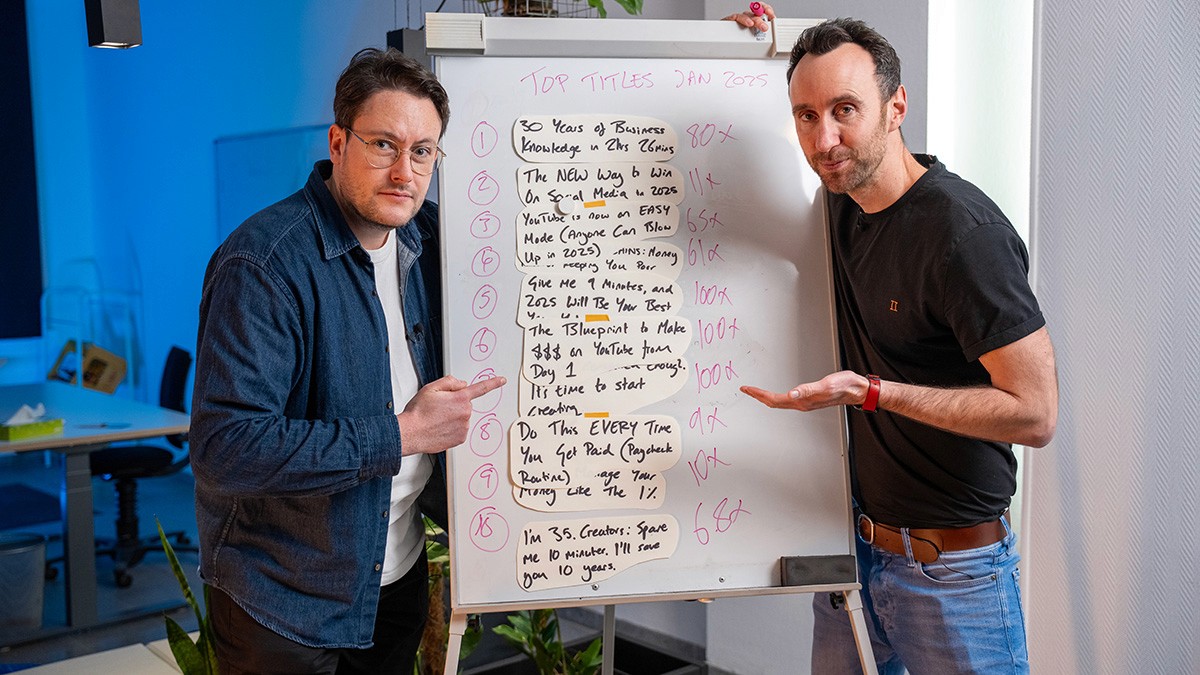
9x is a more recent example, and a particularly instructive one. Their channel had modest early traction until one of the founders made a deliberate decision to dedicate themselves full-time to its growth: as strategist, researcher, and distributor, not just presenter. The results are in their analytics. In the past twelve months, the 9x channel generated 2.8 million views, gained 56,200 new subscribers, and produced over €15,000 in ad revenue, before accounting for the product revenue that flows through it. Their videos on AI tools and productivity now regularly clear 100,000 to 400,000 views.
That growth pattern—a long flat baseline, then a series of sharp inflection points as the content and distribution systems lock in—is exactly what business YouTube looks like when someone commits to it properly. It takes time. But it is repeatable.
6 Questions to Ask Before You Start
1. Do you have something genuinely useful to teach your audience?
YouTube rewards expertise. If your team has knowledge your customers are actively searching for—how-tos, explainers, tutorials, industry insight, career guidance—you have the raw material. CareerFoundry succeeded because it was genuinely the right source for content about breaking into tech. Babbel succeeded because they had people on staff who could learn a language in a week and make that process compelling to watch.
YouTube viewers have no reason to subscribe to a company's press office. They subscribe to channels that make them better at something, or that make their working lives easier. If your only content idea is product launches and company announcements, that's a signal worth taking seriously before you spend money on a camera.
2. Do you have at least one person willing to be on camera?
Not necessarily charismatic, not necessarily polished, but credible, consistent, and willing to show up on camera week after week. The best business channels are built on a face people trust and, over time, come to feel they know. The presenter doesn't need to be a natural. They need to be genuine and willing to improve.
CareerFoundry used senior instructors and career changers. Babbel used polyglots and language experts. 9x uses their founders. In each case, the person on camera had real authority in the subject matter and was willing to develop their on-camera presence over time, rather than waiting until it felt perfect. Who would that person be at your company?
3. Can your stakeholders commit for at least six months?
YouTube is a channel that rewards patience and punishes short-termism. Businesses that treat it like a campaign—a few videos, no immediate traction, pull the plug—waste their investment and walk away with a clear data point about what didn't work, without ever getting close to what could. The channels that win are built by teams with patient stakeholders, a clear measurement framework, and enough runway to let the content compound.
This is often the hardest question to answer honestly, because it depends less on YouTube than on your internal culture. If your leadership will pull budget after ninety days because they can't see the ROI, YouTube will fail before it has a chance to prove itself, not because it doesn't work, but because it wasn't given the right conditions to show that it does.
4. Do you have a funnel to send viewers into?
A YouTube channel without a clear next step is a brand exercise. Before you film anything, you need somewhere meaningful to send viewers: a lead magnet, a free course, a webinar, a booking page, a trial offer. Something with low enough friction that a viewer who's just spent twelve minutes learning from you will actually take the next step.
CareerFoundry's funnel converted YouTube-sourced website visits into qualified leads at around 27%, because the free course offered in the video description was a logical, low-friction next step for someone already considering a career change. That doesn't happen by accident. It requires intentional design before the first video is published. Do you have that infrastructure in place, or can you build it before you start?
5. Are you prepared to measure it properly?
The most common reason YouTube fails for businesses isn't the content — it's the measurement. Or rather, the absence of it. Without a clear attribution framework, there's no way to demonstrate the channel's value to leadership, which means the first time growth is slower than expected, the budget conversation becomes very difficult.
The basics aren't complicated. Tagged links in video descriptions. Self-reported attribution in your sign-up flows ('how did you hear about us?'). A simple funnel view that connects views to visits to leads to revenue. These steps don't require a data team. They require intention before you launch. For a full walkthrough of how to build this properly, our piece on YouTube distribution strategy covers the measurement and attribution side in detail, alongside the distribution system that makes the data worth tracking.
6. Does YouTube fit your broader content ecosystem?
The businesses that get the most from YouTube treat it as a content hub, not an isolated channel. Every video CareerFoundry published became a blog post; the blog post embedded the video; email sequences drove traffic back to the channel; LinkedIn clips extended reach into audiences who hadn't found the channel yet. That distribution web is what accelerated early growth before the algorithm had enough signal to push the content independently.
YouTube works best when it improves your entire marketing operation: the long-form video lifts your blog's dwell time, the script becomes a lead magnet, the Shorts feed your social channels. If that integrated approach energises you, it's a strong signal. If YouTube feels like yet another channel to manage in isolation — on top of everything else — that's worth examining before you start. The YouTube distribution strategy guide maps out exactly how to build that hub model from the ground up.
If You Answered Yes to Most of Those
The practical next step is channel positioning: defining your single, obvious reason to exist on YouTube, mapping your funnel, and identifying the formats that will carry your expertise most effectively. How to Grow a YouTube Channel from 0 Subscribers for Your Business walks through the full 7-phase system we use with clients, from positioning through to distribution and measurement. And if you want a sense of what best-in-class looks like across the industry, our guide to the best YouTube agencies is a useful benchmark for understanding what serious YouTube investment actually produces.
If You Answered No to Several
That doesn't mean YouTube is wrong for your business. It may mean the timing or the infrastructure isn't quite there yet. The most common gaps we see are: no clear funnel to send viewers into, no internal champion willing to get on camera consistently, or stakeholder expectations that are out of step with how YouTube growth actually works.
Each of those is solvable. The funnel can be built before launch. The right presenter is usually in the business already, they just need to be identified and committed. And stakeholder expectations can be managed with the right measurement framework from day one. Working through these gaps before you start is significantly less painful than discovering them six months into production.
The Bottom Line
YouTube is one of the most durable and commercially valuable marketing channels available to businesses with genuine expertise and a defined audience. A video published today can generate leads three years from now. A channel built this year can be producing more views in five years than it does at launch, without additional investment in distribution. That kind of compounding resilience is rare in marketing.
If you're at the point of thinking seriously about what YouTube could do for your business, we're happy to have that conversation. Humble&Brag works with startups and scale-ups at exactly this stage: helping them figure out whether YouTube is right for them, building the strategy if it is, and running the execution if they need us to. You can read more about how we work in our guide to choosing a YouTube agency, or just get in touch directly.