BLOG OVERVIEW
How to Choose a YouTube Agency: A CMO's Guide to Hiring the Right Partner
In
YouTube Agency
by
Edward Wood
Hiring the wrong YouTube agency costs you six to twelve months and anywhere from €50,000 to €150,000. And unlike a bad Meta Ads campaign that you can diagnose and correct in a few weeks, a failed YouTube partnership leaves you with months of wasted content, a demoralised team, and a leadership that's now sceptical about the entire channel.
Most CMOs evaluate YouTube agencies the way they'd evaluate an ad agency or a design studio: look at the portfolio, check the pricing, and go with whoever seems most impressive. But choosing a YouTube partner is a fundamentally different decision. You're not buying a deliverable; you're choosing a growth partner for twelve to twenty-four months.
Having been on both sides of this decision, as CMO hiring agencies and now running one, here's the framework I wish I'd had.
Before You Evaluate Anyone: Know What You Need
The most common hiring mistake happens before the first agency call. Companies approach YouTube agencies without clarity on what they actually need, which means they can't evaluate whether an agency is the right fit.
Run through this quick self-assessment first. Do you need production only, meaning someone to film and edit, or do you need full-stack growth including strategy, production, optimisation, distribution, and measurement? What are your timeline expectations: are you prepared to invest for twelve months, or does your CEO need results in three? What internal resources do you already have, including whether someone can be on camera regularly? What's your realistic monthly budget: €5,000, €15,000, €30,000? And how will you define success: views, subscribers, leads, or revenue?
Getting clear on these questions prevents the single most expensive mistake in this space: hiring a production agency when you need a growth agency, or the other way around.
Portfolio Analysis: What to Actually Look For
Every YouTube agency has a portfolio. The question is whether you're reading it correctly.
Growth Trajectory, Not Endpoint Numbers
Don't be dazzled by a channel with 200,000 subscribers. Ask instead: what did that channel look like when the agency started? What was the growth rate month by month? How long did it take before momentum kicked in? What were the breakthrough videos, and were they strategically planned or accidental?
The best indicator of an agency's capability isn't the channels they manage now, but what those channels looked like at the beginning and how the growth unfolded over time. Any decent agency should be able to walk you through the journey, including the slow months, with analytics to back it up.
Business Channels vs Creator Channels
This distinction cannot be overstated. Growing a creator channel and growing a business channel require fundamentally different strategies, different content approaches, and different success metrics. A creator optimises for ad revenue and sponsorship value, which means maximising broad viewership. A business optimises for qualified leads and customer acquisition, which means reaching the right people, even if total views are lower.
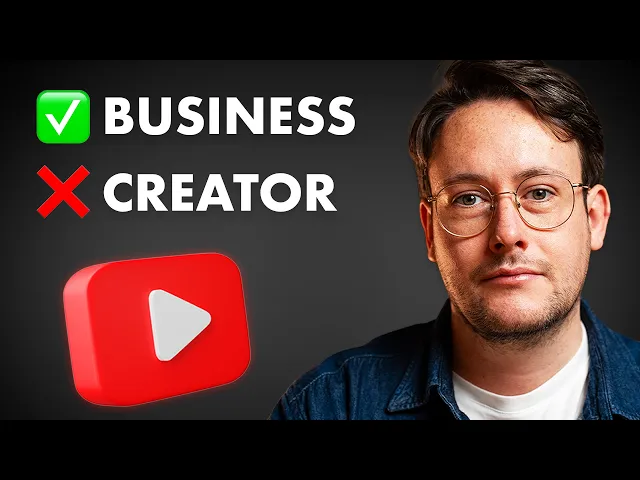
If an agency's portfolio is entirely creator channels, that's a significant red flag. If they have a mix of B2B and B2C business channels, you're in much better territory. And if they've grown channels in adjacent industries to yours, even better, though an exact industry match is less important than a solid understanding of how business channels work.
Current Performance, Not Historical Peaks
Check whether the channels in an agency's portfolio are still growing. A channel that spiked two years ago and has been flat since tells a very different story than one that's still compounding. Ask to see current monthly views, not all-time stats. The recency and sustainability of growth matter more than peak numbers.
The 15 Essential Questions to Ask
About Their Process
"Walk me through your onboarding process." A serious agency should describe a two-to-four-week discovery and strategy phase before any cameras roll. If they want to start filming in week one, they're skipping the work that determines whether the content will actually resonate. We run a strategy workshop with every client precisely because this foundational work determines everything that follows.
"How do you decide which videos to make?" The answer should involve data: competitor analysis, keyword research, audience signals, performance data from existing content. If the answer is "we brainstorm ideas," that's instinct-driven, not evidence-driven.
"What's your production workflow?" You're looking for a systemised process, not ad-hoc. Batch filming, standardised editing workflows, thumbnail design processes, and quality control checkpoints all indicate maturity.
"How often will we communicate?" Weekly at minimum in the early months, with formal monthly strategy reviews. If an agency is vague about communication cadence, expect to feel ignored once the contract is signed.
About Results
"Can you show me a channel that didn't meet expectations?" This is an honesty test. Every agency has projects that underperformed. How they talk about those projects, what they learned, what they'd do differently, tells you more about their competence than any success story.
"What's a realistic timeline for our situation?" The answer should be specific to your circumstances, not a generic promise. A channel starting from zero in a competitive niche will grow differently than one in an underserved category with an existing audience to tap into. If they give you a one-size-fits-all answer, they haven't thought deeply about your situation.
"How do you measure success beyond vanity metrics?" This should lead to a conversation about revenue attribution, lead tracking, funnel metrics, and business impact. If it leads to a conversation about likes and comments, you've got a problem.
"What happens if videos underperform?" Listen for a systematic response: data analysis, diagnosis, hypothesis, iteration. Not "we'll try harder next time."
About the Team
"Who specifically will work on our account?" Get names, backgrounds, and experience levels. You want to know whether senior people are involved in your account or whether it's been delegated entirely to juniors.
"How many clients do they manage?" An account manager handling fifteen clients simultaneously won't give you the attention you need. Quality matters more than headcount.
"Will we work with freelancers or an in-house team?" Neither answer is inherently wrong, but you should know. A team of curated freelancers can be excellent; you just want transparency about who's doing the work.
About Strategy
"How do you approach channel positioning?" A clear methodology here, one they can articulate without stumbling, suggests they've thought deeply about this and done it many times before. As we describe in our approach to channel positioning, this step determines the shape of everything that follows.
"How will YouTube integrate with our other channels?" The answer should reference your email marketing, SEO, paid media, and social channels. YouTube in isolation underperforms dramatically compared to YouTube embedded within a broader marketing ecosystem.
"What conversion funnel will you build?" This question separates growth agencies from production agencies. If they look confused, they're in the wrong category.
Evaluating Their Strategic Thinking
Beyond the specific questions, pay attention to how the agency behaves during the sales process. This is a reliable preview of what it'll be like working with them.
Do They Ask Great Questions?
The best agencies spend more time listening than pitching in the first meeting. They should be asking about your business model, your customers, your competitors, your current marketing mix and what's working, your goals and constraints, your internal resources and team dynamics. An agency that launches into a pitch without deeply understanding your situation is an agency that will build a strategy based on assumptions rather than evidence.
Do They Challenge Your Assumptions?
If you walk in saying "we want reaction content because our competitor does it," does the agency nod along, or do they ask why that format serves your specific business goals? Do they push back on unrealistic timelines? Do they tell you what you need to hear rather than what you want to hear?
The best agencies are advisors, not order-takers. They bring a perspective you don't have, and they're willing to disagree with you when it matters. That can feel uncomfortable in a sales process, but it's exactly the kind of partnership that produces results.
Pricing and Contract Evaluation
Scope Clarity
The proposal should specify exactly how many videos per month, what's included in "one video" (scripting, filming, editing, thumbnail, optimisation), how many revision rounds are included, and what costs extra. Vague scope language like "content creation and strategy support" is an invitation for misaligned expectations and budget overruns.
Pricing Structure
Understand whether you're looking at a monthly retainer, a project-based fee, or some hybrid. Know the minimum commitment period and what happens if you want to exit early. Are onboarding fees separate? Is there a ramp-up period where costs differ from the ongoing rate? For a more detailed breakdown of how different pricing models work, see our guide to YouTube agency pricing models.
Ownership Terms
This is critically important and often overlooked. Who owns the content? Who owns the channel? What happens to the videos if you part ways? Can you repurpose content freely? Get this in writing before you sign anything.
Reference Checks That Actually Matter
When an agency provides references, don't just ask "were they good?" Ask questions that reveal real information.
Ask the reference what the biggest challenge was in working with the agency. Ask whether they delivered on time and on budget. Ask how the agency handled videos that underperformed, because this reveals their problem-solving capability under pressure. Ask whether the reference would hire them again, and listen carefully to the phrasing. Ask what surprised them, both positively and negatively. And ask what the agency could have done better.
Red flags during reference checks include agencies that can't provide any references at all, references that are from more than two years ago, and references that are for a fundamentally different service than what you're buying. If they grew a creator's cooking channel and you're a B2B SaaS company, that reference has limited relevance.
The Decision Scorecard
To make your evaluation systematic rather than gut-driven, rate each agency on a ten-point scale across five dimensions.
Strategic Capability (Weight: 25%). How strong is their channel positioning approach? Do they have a clear content strategy methodology? Are they focused on business results, not just content output?
Execution Quality (Weight: 25%). How strong is their portfolio? What's the production quality like? Do they sweat the details on thumbnails, titles, and optimisation?
Team and Expertise (Weight: 20%). Are senior team members involved in your account? Do they have relevant experience with business channels? Does the team appear stable, or is there high turnover?
Communication and Process (Weight: 15%). How responsive were they during the sales process? Is their process clearly articulated? What does their reporting and transparency look like?
Business Alignment (Weight: 15%). Do they understand your specific goals? Are pricing and contract terms reasonable? Is there a cultural fit that suggests the day-to-day will be smooth?
Multiply each score by its weight to get a weighted total out of 100. Agencies scoring 80 to 100 are strong candidates to move forward with. Those scoring 65 to 79 warrant proceeding with caution and clarifying your concerns first. Below 65, keep looking.
Making the Final Decision
Choosing a YouTube agency is choosing a growth partner for the next one to two years. Don't rush it because of timeline pressure. Better to wait two months for the right partner than to start immediately with the wrong one.
Use this framework to evaluate objectively, but also trust your gut on culture fit. The best strategic match in the world won't work if communication is consistently frustrating or if your working styles clash.
And remember: the goal isn't to find the cheapest option or the flashiest portfolio. It's to find the agency that understands your business, has proven systems for growth, and will treat your channel with the same rigour they'd apply to their own.
If you'd like help evaluating your options or want to discuss what the right partnership might look like for your company, let's have a conversation.